Old English guide
Old English Grammar: Cases, Nouns, Verbs, and Sentence Structure
Old English grammar becomes easier to understand once you stop looking for a separate Modern English word to represent every meaning. In Old English, a word's ending , the form of a nearby determiner, or a change inside a verb can tell you who is acting, who receives something, and when an action takes place.
Consider the difference between stÄn (stone), stÄnes (of a stone), and stÄnum (to or for stones, or stones after certain prepositions). These are related forms, not three unrelated vocabulary items. Recognizing their relationship is one of the most useful skills for reading Old English.
This guide explains the working system behind such forms: four principal cases, grammatical gender, strong and weak declensions, adjective agreement, pronouns, verb conjugation, and sentence structure. The examples use broadly normalized Old English spellings, principally the West Saxon forms commonly taught to beginners. Where a sentence has been constructed for instruction, it is identified as such.
The Four Cases: What a Noun Does in a Sentence
Modern English has traces of case in he/him/his, but an ordinary noun such as stone barely changes: stone, stones, stone’s. Old English used case distinctions throughout noun phrases. A noun, article-like determiner, or adjective could change form to show its grammatical role.
| Case | Common function | Question it helps answer |
|---|---|---|
| Nominative | Subject or subject complement | Who or what performs the action? |
| Accusative | Direct object; also used after certain prepositions | Whom or what does the action affect? |
| Genitive | Possession or other relationships between nouns | Whose? Of what? |
| Dative | Indirect object; common after prepositions and certain verbs | To or for whom? In or with what context? |
Those descriptions are starting points, not inflexible translation rules. A dative is not always translated with to, and not every accusative is a direct object. The particular verb or preposition can determine which case is required.
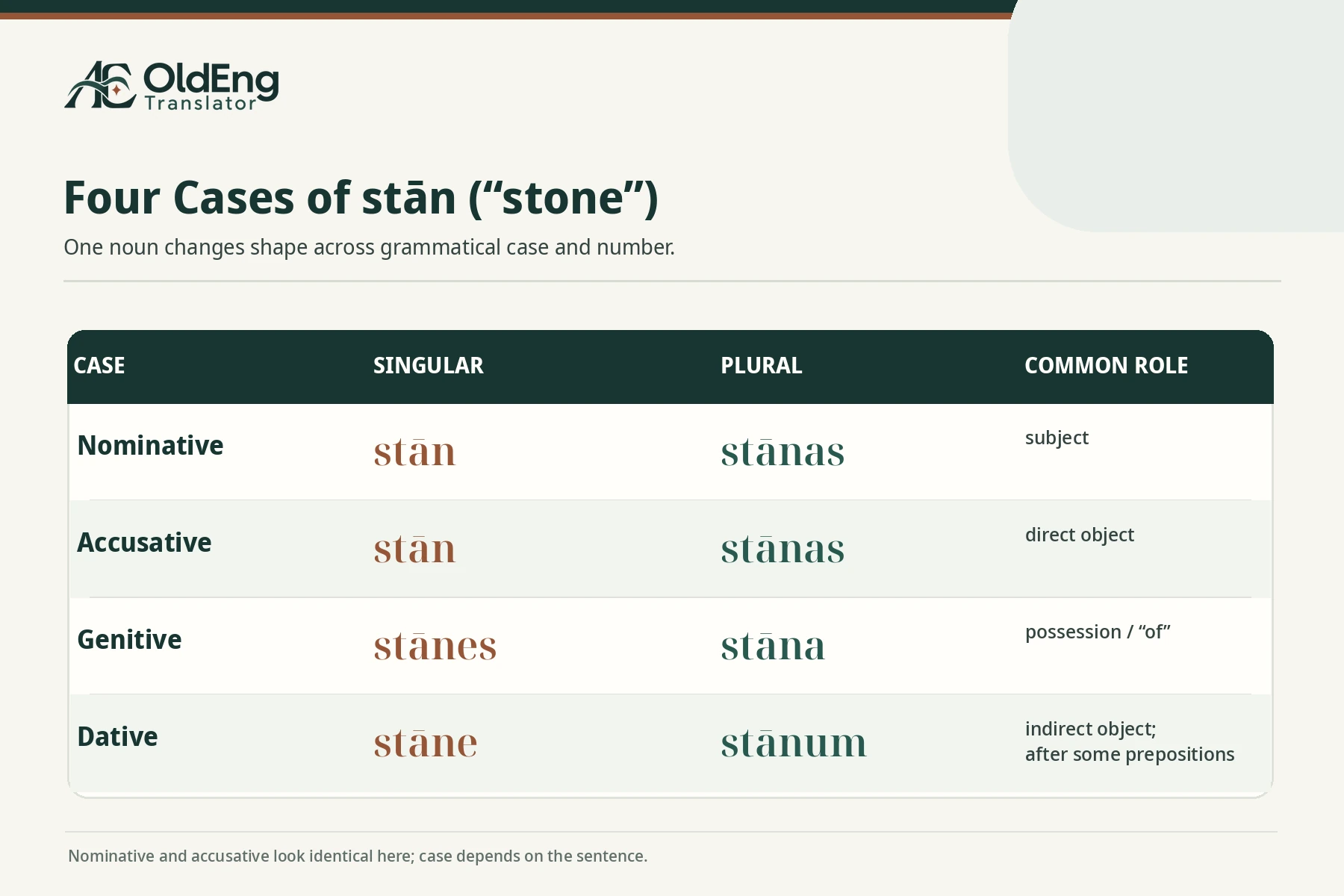
A compact example is the masculine noun stÄn:
| Case | Singular | Plural |
|---|---|---|
| Nominative | stÄn | stÄnas |
| Accusative | stÄn | stÄnas |
| Genitive | stÄnes | stÄna |
| Dative | stÄne | stÄnum |
Notice two things. The nominative and accusative forms happen to be identical here; case does not always produce a visibly different noun. And stÄnum is dative plural, not simply another spelling of the singular word. The form must be interpreted in its sentence.
The genitive often appears in noun phrases such as þæs cyninges stÄn, “the king’s stone.†Both þæs and cyninges help mark the possessive relationship. Old English is not simply attaching -es to everything that is owned; the endings belong to a grammatical system with different noun classes.
Some descriptions also recognize an instrumental case, particularly in remnants of older forms and some determiners. For a beginner reading ordinary prose, the four cases above provide the essential framework; the instrumental should not be mistaken for a fifth fully productive case in every noun paradigm.
Gender and Determiners: Why “The†Has Different Forms
Old English nouns belong to masculine, feminine, or neuter grammatical genders. These categories need not match natural sex. For example, wÄ«f (“woman†or “wifeâ€) is grammatically neuter, while sunne (“sunâ€) is feminine. Gender matters because words accompanying a noun often have to agree with it.
Old English used forms of a demonstrative, often translated the or that, which varied with gender, number, and case. These examples retain letters such as þ and modern editorial vowel marks; the Old English Alphabet guide explains the written conventions. Its most important singular forms are:
| Case | Masculine | Feminine | Neuter |
|---|---|---|---|
| Nominative | se | sēo | þæt |
| Accusative | þone | Ã¾Ä | þæt |
| Genitive | þæs | þǣre | þæs |
| Dative | þÄm | þǣre | þÄm |
For the plural, Ã¾Ä serves as nominative and accusative across genders, þÄra as genitive, and þÄm as dative. Some editions print alternate spellings, including þǣm instead of þÄm.
Compare se cyning (“the king,†nominative) with þone cyning (“the king,†accusative). The noun cyning has not changed, but the determiner identifies a different role. Likewise, sÄ“o cwÄ“n is feminine nominative, while Ã¾Ä cwÄ“ne is feminine accusative. A reader who looks only at the noun’s final letters can miss the evidence sitting immediately before it.
Old English did not have a regular indefinite article working exactly like Modern English a/an. Ä€n (“oneâ€) and sum (“a certain, someâ€) could have related uses, but a bare noun may be the most appropriate rendering of an English indefinite expression. Translating “a king†by inserting Än automatically is therefore not always justified.
Strong, Weak, and Irregular Nouns
A declension is a pattern of noun forms across case and number. In traditional Old English grammar, many nouns belong to strong declensions, while another substantial group belongs to a weak or -an declension. “Strong†here is the name of an inflectional class; it is not a description of a noun’s meaning or emphasis.
The masculine noun stÄn follows a common strong pattern, but not all strong nouns use exactly its endings. For example, neuter scip (“shipâ€) has nominative and accusative plural scipu, not scipas.
Weak nouns often share -an in several forms. Take the masculine noun nama (“nameâ€):
| Case | Singular | Plural |
|---|---|---|
| Nominative | nama | naman |
| Accusative | naman | naman |
| Genitive | naman | namena |
| Dative | naman | namum |
Here the same singular form naman can be accusative, genitive, or dative. A dictionary lookup may find nama as the headword even when the text has naman. The ending narrows the possibilities, but context still has to decide between them.
Some nouns also change their stem vowel. FÅt (“footâ€) has plural fÄ“t; mann (“person, manâ€) has plural menn. These patterns remind readers that recognizing a plural is not always a matter of locating -as or -an. Historical spelling variation can add another layer of difficulty, but the grammatical task is still to connect a form to its noun and determine its function.
Adjectives Agree with Nouns, but Their Pattern Can Change
Modern English says a good king and the good king: good stays the same. Old English adjectives had forms for gender, number, and case, and they also followed strong or weak adjective patterns according to their grammatical setting.
A short contrast illustrates the difference:
| Construction | Old English | Meaning |
|---|---|---|
| Strong adjective, nominative masculine | gÅd cyning | a good king / good king |
| Weak adjective after determiner | se gÅda cyning | the good king |
| Strong adjective, accusative masculine | gÅdne cyning | a good king as direct object |
| Weak adjective, accusative masculine | þone gÅdan cyning | the good king as direct object |
These are deliberately short illustrative noun phrases rather than quotations from a manuscript. They show that the adjective changes with the noun phrase’s structure. The word’s meaning remains good, but the form carries grammatical information.
The usual beginner rule is that an adjective following a definite determiner takes the weak pattern, while one without such a determiner generally takes the strong pattern. Actual Old English usage includes qualifications, especially with possessives, names, and particular constructions; the labels are not substitutes for checking a real sentence.
Do not confuse strong and weak adjectives with strong and weak verbs. The same traditional terms are used, but verbs are classified chiefly by how they form their past tense, not by whether an article precedes them. Nouns follow their own declension classes. Keeping those three uses separate avoids a common misunderstanding.
Pronouns: Familiar Words with Less Familiar Forms
Old English personal pronouns preserve distinctions that most Modern English pronouns no longer display. Forms such as ic (I), mē (me), wē (we), and ūs (us) may seem partly recognizable, but their case matters.
| Person | Subject form | Object or dative form | Genitive form |
|---|---|---|---|
| First-person singular | ic | mē | mīn |
| Second-person singular | þū | þē | þīn |
| Third-person masculine singular | hē | hine (acc.); him (dat.) | his |
| First-person plural | wē | ūs | ūre |
| Second-person plural | gē | ēow | ēower |
The table is a recognition aid, not a complete pronoun paradigm. In particular, forms such as mīn and þīn can also serve possessive functions and inflect when used with nouns. The full third-person system distinguishes masculine, feminine, and neuter singular forms.
Old English also had dual pronouns for precisely two people: wit meant “we two,†and git meant “you two.†These forms did not survive as ordinary Modern English pronouns. They matter when a text makes a two-person relationship explicit, but beginners need not confuse dual pronouns with a separate dual ending for every noun.
A useful reading habit is to identify a pronoun’s person, number, and case before guessing its role. The form him, for example, is not merely interchangeable with every Modern English use of him: in Old English it is specifically a dative form in the traditional paradigm.
Old English Verbs: Person, Tense, and Mood
An Old English finite verb can reveal who performs an action and whether the action is present or past. Verbs also express mood: the speaker may be stating something, issuing a command, or describing a possibility or wish.
Take lufian (“to loveâ€), a weak verb. Selected indicative forms include lufie (“I love,†with some spelling variation), lufast (“you love,†singular), lufaþ (“he, she, or it lovesâ€), and lufiaþ (“we, you, or they loveâ€). The third-person singular ending is different from the plural ending. In the past tense, forms include lufode (“I/he/she lovedâ€) and lufodon (“they lovedâ€).
Strong Verbs and Weak Verbs Do Not Form the Past Alike
Compare two verbs:
| Infinitive | Third-person singular present | Third-person singular past | Past plural | Past participle |
|---|---|---|---|---|
| bindan — bind | bindeþ | band | bundon | (ge)bunden |
| lufian — love | lufaþ | lufode | lufodon | (ge)lufod |
Bindan is strong: its past-tense forms show a change in the stem vowel (bind-, band-, bund-). Lufian is weak: the past forms use a dental suffix, visible in -od-. Other verb classes have other vowel changes and suffixes, so neither line is a universal conjugation chart.
The optional ge- in the participles reflects a prefix commonly found on past participles, not a compulsory mark that can be added mechanically to any form. The vowel alternations also changed in sound over the centuries; the Old English Pronunciation guide explains why modern-looking spellings cannot be read as Modern English sounds. Frequent verbs such as wesan/bÄ“on (“to beâ€) also have irregular patterns: compare is, wæs, and wÇ£ron. Such forms must be recognized as a family even though they do not all share one visible stem.
Why Old English Does Not Have One Simple Future Ending
The finite tense system primarily contrasts present and preterite (past). Future meaning could be conveyed through the present tense and context. Constructions with verbs such as willan or sculan developed uses that relate to futurity, but willan often expresses willingness or intention rather than the Modern English auxiliary will.
Mood matters too. The indicative normally presents statements; the imperative gives commands; the subjunctive appears in wishes, possibilities, reported thought, and some subordinate clauses. For example, þæt hē cume can convey “that he may/should come,†depending on the larger construction. Its meaning is not fixed by the word cume alone.
Negation often uses ne before the verb, and it can merge with a following form: nis corresponds to ne is (“is notâ€). Multiple negative expressions can also occur in grammatical Old English constructions, so imposing Modern English classroom rules on them can produce a false reading.
Word Order: Flexible Is Not the Same as Random
Old English frequently permits arrangements that would be difficult or misleading in ordinary Modern English. Because determiners and nouns carry case information, an object can sometimes precede a subject without swapping their roles.
Consider this constructed teaching sentence:
SÄ“o cwÄ“n sealde þÄm cyninge Ã¾Ä bÅc. The queen gave the king the book.
| Part | Grammatical role | Reason |
|---|---|---|
| Sēo cwēn | Subject | Feminine singular nominative: the queen |
| sealde | Verb | Past-tense form of sellan, “to give†|
| þÄm cyninge | Recipient | Masculine singular dative: to the king |
| Ã¾Ä bÅc | Direct object | Feminine singular accusative: the book |
Now move the recipient forward: ÞÄm cyninge sealde sÄ“o cwÄ“n Ã¾Ä bÅc. The basic relationships remain recoverable because þÄm marks the recipient and sÄ“o marks the subject. The difference is not that Old English ignores word order: a fronted phrase can affect emphasis and information structure, and prose still has recognizable preferences.
In many main clauses, the finite verb occurs relatively early; after certain opening adverbs, it can precede the subject. In subordinate clauses, the verb may occur later. Poetry can use additional flexibility for meter, alliteration, or style. And where case forms overlap, word order and context become more important, not less.
The same caution applies to prepositions. A preposition such as on can govern different cases depending on use and meaning; it is unsafe to translate a noun phrase solely from the preposition’s nearest Modern English equivalent. Read the whole grammatical construction.
How to Work Out the Grammar of an Unfamiliar Passage
Instead of translating from left to right and choosing the first dictionary meaning for each word, use a short sequence of checks.
Find the finite verb. Look for an ending or recognizable stem suggesting a present or past form. If several verbs appear, determine which belongs to the main clause and which belongs to a subordinate clause.
Identify subjects and objects using forms, not just position. Look for determiners such as se, sÄ“o, þone, and þÄm. A noun with an unchanged ending may still be marked by the word beside it.
Recover dictionary headwords. An unfamiliar stÄnum should be investigated under stÄn, not assumed to be a distinct headword. For verbs, a past form such as band belongs with bindan, despite the vowel change.
Test the relationships before composing smooth English. Work out whether a genitive expresses possession, whether a dative follows a particular verb or preposition, and whether a subjunctive changes the force of a clause. Only then decide on natural Modern English wording.
As a compact exercise, try to identify these three forms before checking the answers:
- þæs stÄnes
- þÄm stÄnum
- lufodon
The first is genitive singular (“of the stone†or “the stone’sâ€); the second is dative plural (“to/for the stones,†or another dative meaning depending on context); the third is a weak-verb past plural (“they/we/you loved,†with the subject supplied by the sentence). The forms illustrate why a dictionary gloss by itself is not enough to translate a passage. This grammatical system belonged to a language that changed across regions and centuries; the historical context in What Is Old English? helps explain why real manuscript forms do not always match a single teaching paradigm.
When checking a passage’s possible meaning, the Old English Translator can assist with exploration, but the relevant forms and context should decide whether a proposed interpretation is convincing.
For a structured academic reference to these grammatical categories and paradigms, consult the University of Glasgow’s *Essentials of Old English*. Its noun, determiner, adjective, and verb tables also help explain why a single visible ending may have several possible grammatical analyses.
Old English grammar is most manageable when treated as a system of relationships rather than a long list of endings to memorize. A form identifies possibilities; the noun phrase, verb, and clause help determine which possibility the text actually uses.
Written by Arthur Westmer Editorial review: OldEngTranslator.com Editorial Team