Old English guide
Old English Dialects: Northumbrian, Mercian, Kentish, and West Saxon
Two surviving versions of Cædmon’s Hymn begin with words that mean much the same thing but look noticeably different. A Northumbrian text has Nu scylun hergan ; a West Saxon version has Nu sculon herigean . Both open with a call to praise, yet the forms reflect different regional and manuscript traditions. Old English was never a single, unchanging variety spoken identically across early medieval England.
Scholars traditionally distinguish four main Old English dialect groups: Northumbrian, Mercian, Kentish, and West Saxon. Their boundaries are approximate, and the evidence for each is uneven. The point of studying them is not to memorize four alternative alphabets. It is to recognize why a word, vowel, grammatical ending, or entire passage may differ from the form printed in an introductory grammar.
The Four Old English Dialects at a Glance
| Dialect | Broad historical area | Especially useful surviving evidence |
|---|---|---|
| Northumbrian | Northern England, broadly north of the Humber, including areas of early Northumbrian influence farther north | Early versions of Cædmon’s Hymn; the later Old English gloss of the Lindisfarne Gospels |
| Mercian | The Midlands, associated with the kingdom of Mercia | The Old English gloss of the Vespasian Psalter; parts of the Rushworth Gospels gloss |
| Kentish | Kent and the southeast | Kentish charters and glosses; the Kentish Hymn and Kentish Psalm |
| West Saxon | Wessex and much of the south and southwest | Prose associated with Alfred’s educational programme; many tenth- and eleventh-century literary manuscripts |
Northumbrian and Mercian are often grouped under the wider label Anglian. That grouping is useful because they share a number of historical sound developments, but it does not erase differences within northern and Midland English.
These are linguistic regions, not four permanently fenced territories. Kingdoms changed their borders, people moved, and books circulated. The label attached to a written text usually describes the linguistic features scholars identify in it; it does not prove where every speaker of that form lived.
What Counts as Evidence for a Dialect?
We know about Old English dialects primarily through written evidence: manuscripts, marginal glosses, charters, inscriptions, and spellings in texts preserved by later copyists. No recordings survive, and written usage tells us more about trained scribes than about every ordinary conversation.
A scholar may recognize regional features in a recurring vowel spelling, a verb ending, or the way a familiar word is formed. A cluster of features is more persuasive than a single unusual spelling. Comparing copies of related works can also help, especially when one witness displays forms associated with the north while another has southern forms.
The complications are just as important:
- A text may be older than its surviving copy. A tenth-century scribe could reproduce or adapt wording composed much earlier.
- A scribe may change the dialect of an exemplar. Copying could involve replacing unfamiliar forms with ones familiar to the new scribe.
- A manuscript can contain more than one linguistic layer. Latin text, Old English glosses, and later annotations may have different dates and origins.
- Spelling is not a perfect record of speech. Individual habits, schools, and editorial normalization can make a regional feature look more or less prominent.
Consequently, “written in Northumbria†and “written in the Northumbrian dialect†are not interchangeable claims. The language of a text must be examined, not merely inferred from a monastery’s location.
Northumbrian: Early Verse and Northern Glosses
Northumbrian provides some of the earliest surviving extended evidence for Old English poetry. Cædmon’s Hymn is associated with a poet in the seventh-century kingdom of Northumbria, and Northumbrian versions were added to copies of Bede’s Latin Ecclesiastical History during the eighth century.
The surviving opening Nu scylun hergan hefaenricaes uard offers recognizable meanings beneath unfamiliar spelling: “Now we must praise the guardian of heaven’s kingdom.†The forms scylun, hergan, and uard do not look quite like the West Saxon equivalents familiar from many school editions. Their differences make the poem particularly useful for comparing written varieties.
A second major witness is the Lindisfarne Gospels. The beautifully decorated Gospel book itself was produced around the beginning of the eighth century in Latin. Its Old English translation was added between the Latin lines by Aldred in the tenth century. That interlinear gloss is evidence for a much later northern form of Old English; the date of the underlying Latin manuscript is not the date of the vernacular translation.
These two sources should not be flattened into a single timeless “Northumbrian accent.†They differ in date, purpose, and textual transmission. Their importance is that they preserve northern language outside the later West Saxon literary tradition.
Mercian: The Midlands Dialect Preserved in Glosses
Mercian is associated with the Midlands and the historically powerful kingdom of Mercia. It belongs to the Anglian group alongside Northumbrian, but the written evidence is concentrated in particular kinds of sources rather than in a large, self-contained Mercian literary library.
The Vespasian Psalter is central. Its Latin Psalms have an Old English interlinear gloss generally identified as Mercian. The gloss is usually assigned to the ninth century, although scholars have debated whether it was composed then or copied from an earlier translation. That uncertainty matters: the features on the page may reflect more than one stage of transmission.
The Rushworth Gospels supply further evidence. Parts of their Old English gloss are Mercian, conventionally distinguished as Rushworth 1, while other sections are associated with a northern glossing tradition. Even one manuscript project can therefore preserve language from more than one regional background.
A gloss places an English rendering beside or between lines of a Latin original. It is valuable for vocabulary, spelling, and inflection, but its syntax can be influenced by the Latin that it follows. This is why a Mercian gloss should not automatically be treated as a perfect sample of spontaneous Mercian speech.
Mercian also matters to the later history of English. Midland varieties formed part of the complex background from which Middle English developed. But it would be misleading to say that modern standard English simply is Mercian, or that one Old English dialect evolved unchanged into present-day speech. The larger transition is examined in Old English vs. Middle English.
Kentish: A Smaller Record with Distinctive Vowels
Kentish is associated with Kent in southeastern England. Its surviving written record is much smaller than the West Saxon corpus, which makes broad claims about its everyday vocabulary and grammar harder to establish.
Some evidence survives in charters and glosses. Two particularly useful literary witnesses are known as the Kentish Hymn and Kentish Psalm, preserved in British Library manuscript Cotton Vespasian D VI. Most of the relevant manuscript section was copied in the tenth century, and it contains Latin material alongside Old English texts. Their traditional Kentish labels identify the regional character assigned to the writings; they do not mean that every feature of the manuscript belongs exclusively to Kent.
A particularly tangible example appears in the Kentish Hymn. Oxford’s poetry concordance records the phrase hiofenrices weard (roughly “guardian of heaven’s kingdomâ€), where other Old English poems often have heofonrices weard. The differing form of the heaven-compound is real written evidence, but these are occurrences in different poems, not two controlled recordings of the same speaker or the same line.
One important area of variation is the treatment of front vowels. Historical descriptions of Kentish record a tendency for certain earlier front-vowel distinctions to converge toward sounds or spellings represented by e. These developments help explain why a word familiar from a West Saxon teaching text may appear with a different vowel in a southeastern witness.
This is a pattern, not a universal find-and-replace rule: different vowels changed in different environments and at different times. A single e is not enough to identify a manuscript as Kentish. Scholars look for several independent features, together with the text’s date and history.
West Saxon: Why It Dominates Modern Old English Textbooks
West Saxon is the variety associated with Wessex. It is prominent in the surviving written record partly because of the kingdom’s political and educational influence, especially from the reign of Alfred in the ninth century and through the monastic literary culture of the tenth and eleventh centuries.
Scholars distinguish Early West Saxon, associated with the Alfredian period, from Late West Saxon, a later written tradition seen in many surviving manuscripts. The differences are not merely a matter of one older and one newer spelling list; linguistic change and scribal convention both played a part.
The abundance of West Saxon texts makes it practical for introductory courses to teach a normalized West Saxon system. When a grammar gives se, sÄ“o, and þæt, or prints a paradigm of the noun stÄn, it often draws on that teaching tradition. Such forms are valuable reference points, but they should not be projected onto every Northumbrian, Mercian, or Kentish witness unchanged.
Late West Saxon is sometimes described as a written standard because influential scribal centres developed relatively consistent practices and their texts circulated widely. That phrase needs care. It does not imply a national language authority, uniform spelling everywhere, or the disappearance of regional speech. Nor is the large West Saxon manuscript record evidence that all of England spoke the Wessex dialect.
The result is an important imbalance: the most frequently taught written variety is not necessarily the most direct ancestor of every form of later English. Surviving books tell us what was copied and preserved, not how frequently each dialect was spoken.
One Poem in Two Dialect Traditions
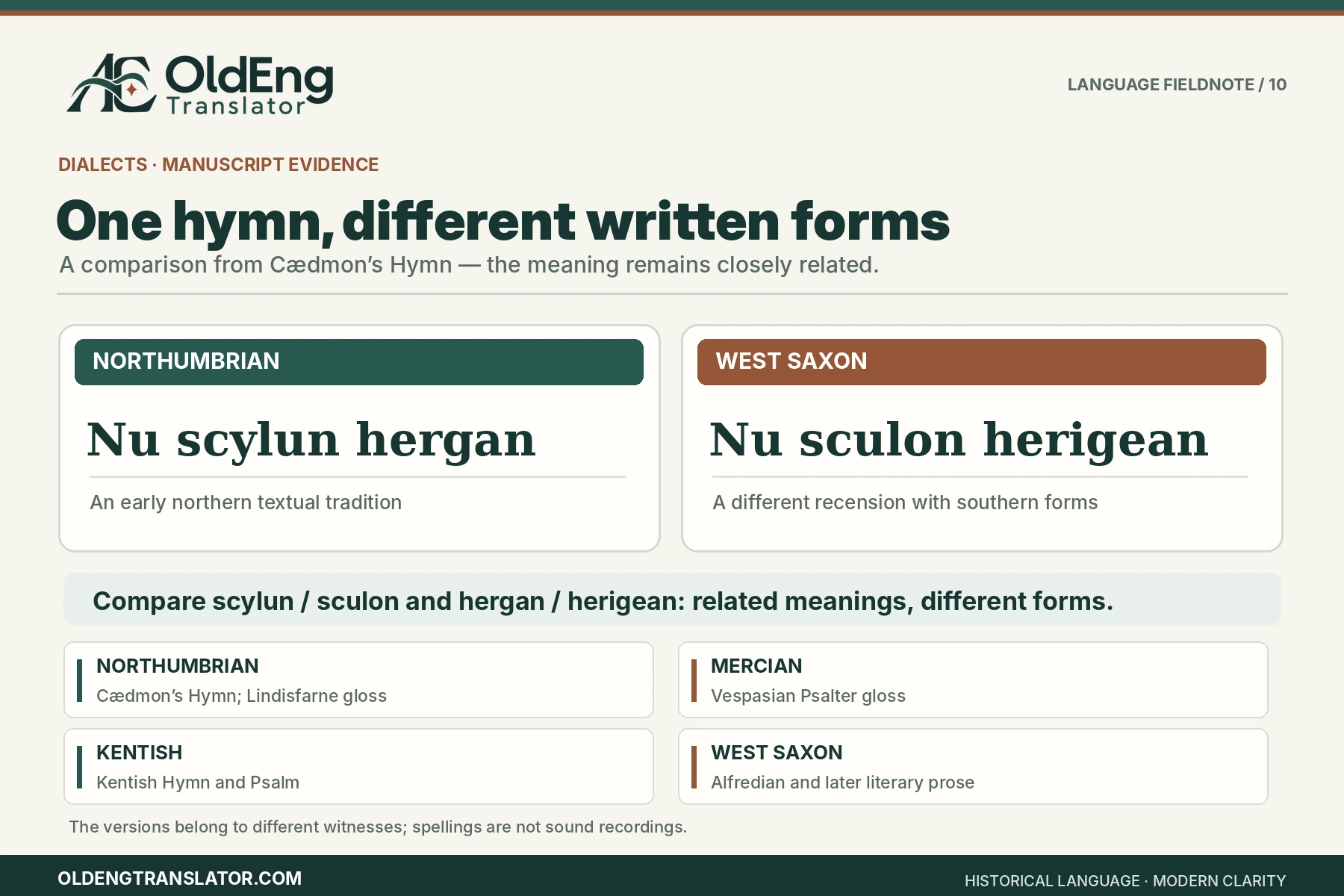
The first line of Cædmon’s Hymn gives a rare opportunity to compare closely related content in distinct regional versions. These readings are presented by Oxford University’s Consolidated Library of Anglo-Saxon Poetry, which includes a Northumbrian version of *Cædmon’s Hymn* and a corresponding West Saxon text.
| Northumbrian reading | West Saxon reading | Broad meaning |
|---|---|---|
| nu scylun | nu sculon | now we must / should |
| hergan | herigean | praise |
| hefaenricaes | heofonrices | of heaven’s kingdom |
| uard | weard | guardian, protector |
Together, the opening means approximately “Now we must praise the guardian of heaven’s kingdom.†The pairings let us observe both difference and continuity. The word for “praise†retains a recognizable core; the heaven-compound varies more visibly; and the protector-word appears with u in the Northumbrian reading and w in the West Saxon one.
This is not a controlled experiment in which two people spoke the same sentence on the same day. The poem survives in multiple manuscripts and recensions. Some differences may reflect dialectal developments; others involve scribal spelling, copying, or the history of the textual versions themselves. The West Saxon form does not tell us that every West Saxon speaker wrote herigean, just as the Northumbrian form does not establish one pronunciation for every northerner.
The comparison is useful precisely because the meanings remain sufficiently close to follow, while the visible words show why a dictionary search based only on one normalized dialect may fail. For the wider history of the hymn and early Old English writing, What Is Old English? explains its manuscript setting.
Which Linguistic Features Actually Varied?
Dialect differences can affect several layers of a text. Their importance becomes clearer if we separate regional language patterns from the habits of individual scribes.
| Feature | Documented type of variation | Why a reader should care |
|---|---|---|
| Vowels | West Saxon ceald and Anglian cald (“coldâ€) reflect different historical treatments of a vowel before l plus a consonant. | A word may have a recognizable consonant frame but a different written vowel. |
| Other vowel combinations | West Saxon eall and Anglian all (“allâ€) illustrate a related difference. | Searching only one spelling may hide a regional form. |
| Inflections | Forms and endings may differ among regional and chronological witnesses. | A grammatical paradigm printed for West Saxon may need adjustment when reading an Anglian gloss. |
| Writing habits | The same sound or word may appear through different letter choices or editorially normalized forms. | A spelling difference alone is not proof of a different pronunciation. |
| Vocabulary and phrase choices | A shared idea may be expressed with a different word or construction across texts. | A single-word equivalence is less reliable than a reading checked in context. |
The ceald/cald and eall/all comparisons are established examples of the broader Anglian-versus-West-Saxon contrast, not exclusive badges by which one can distinguish Northumbrian from Mercian. Historical sound changes also developed over time, so an early and a late text from the same region may look different.
Pronunciation differences cannot be recovered by treating every letter as a transparent sound symbol. The Old English Pronunciation guide explains the reconstructed vowel and consonant systems, including their uncertainty. For manuscript characters and editorial substitutions, the Old English Alphabet reference addresses a separate issue: how the language was written down.
How to Read a Passage That Is Not West Saxon
Suppose a text gives scylun, but your beginner’s reference expects sculon. You do not need to assume the first form is a mistake or that the second belongs to another language. Start by preserving the original reading and checking which regional or editorial conventions your source uses.
A practical approach has four checks:
- Identify the witness. Record the manuscript, edition, or gloss you are reading, including its approximate date if known. Distinguish the date of the text from that of a later copy.
- Look for a pattern, not a single odd spelling. Compare vowels, endings, and familiar words across several lines. One apparent difference may be scribal; repeated related features provide stronger evidence.
- Search possible normalized forms. When scylun is unfamiliar, a reference under sculon or the verb sculan may clarify the connection. Do not replace the original wording in a quotation without explaining the change.
- Check the local grammar and context. A dialect label cannot tell you by itself which sense a word has, who performs an action, or whether a gloss is following Latin word order.
For finding an unfamiliar form under a likely headword, How to Use an Old English Dictionary deals with the lookup problem in detail. When the challenge is turning a whole passage into readable Modern English, use the method in How to Read and Translate Old English. The Old English Translator can help with an exploratory reading, but a tool’s result should not be treated as evidence that the input conforms to one particular historical dialect.
Dialect study changes how we understand the record of English itself. Northumbrian, Mercian, Kentish, and West Saxon are not four competing modern standards; they are names for patterns reconstructed from a surviving body of unequal, often heavily transmitted evidence. The four labels are useful so long as they help us read that evidence more carefully, rather than erase the variation it preserves.
Written by Arthur Westmer Editorial review: OldEngTranslator.com Editorial Team