Old English guide
How to Read and Translate Old English: A Practical Method with Worked Examples
The opening of an entry in the Anglo-Saxon Chronicle reads: Her cuom se here into Escanceastre from Werham. A modern reader may recognize into and from , mistake here for a word about location, and still miss the sentence's meaning. In this chronicle, hÄ“r introduces the year's events, while here names an army. The verb cuom is a past form of cuman , “to come.â€
A defensible translation is “In this year the raiding army came into Exeter from Wareham.†You arrive at that reading by identifying the source, separating the clauses, recovering dictionary forms, and checking what each word is doing in context—not by replacing words in their original order with whatever modern equivalents look familiar.
This guide takes you through that process using a short, genuinely attested prose passage, then shows how the method changes when you need to compose Old English from Modern English. The goal is a translation you can explain and check, not merely a sentence that sounds plausible.
Start by Identifying the Text You Have
Before opening a dictionary, find out whether you are looking at a manuscript transcription, a modern edited text, or a sentence constructed for teaching. They may look similar on screen but are different kinds of evidence.
An edition may substitute w for the historical letter wynn (Æ¿), expand abbreviations, insert punctuation, or add macrons over long vowels. Some editors normalize variant spellings; others deliberately preserve what a particular manuscript says. A change in presentation is not necessarily a change in the historical wording, but it should not go unnoticed when you quote or analyze a passage.
Keep a copy of the exact text as supplied. If you make a normalized working version, label it separately. This is especially important with unfamiliar letterforms, words divided differently in manuscripts, and passages copied in more than one version. Our Old English Alphabet guide explains how character recognition and editorial conventions affect reading.
Also note the genre. A legal provision, a sermon, a chronicle entry, and a poem do not use language in precisely the same way. A single word may have a broad dictionary definition but a narrower use in a military narrative or a religious text. You do not need to study the entire history of the source before translating one sentence; a title, approximate date, and a few lines of context can prevent a major misreading.
A Real Old English Passage, Translated Step by Step
The University of Oxford’s Ashmolean Museum reproduces an Old English Anglo-Saxon Chronicle extract under the annal dated 877 [876], alongside a modern translation. Its opening clause is:
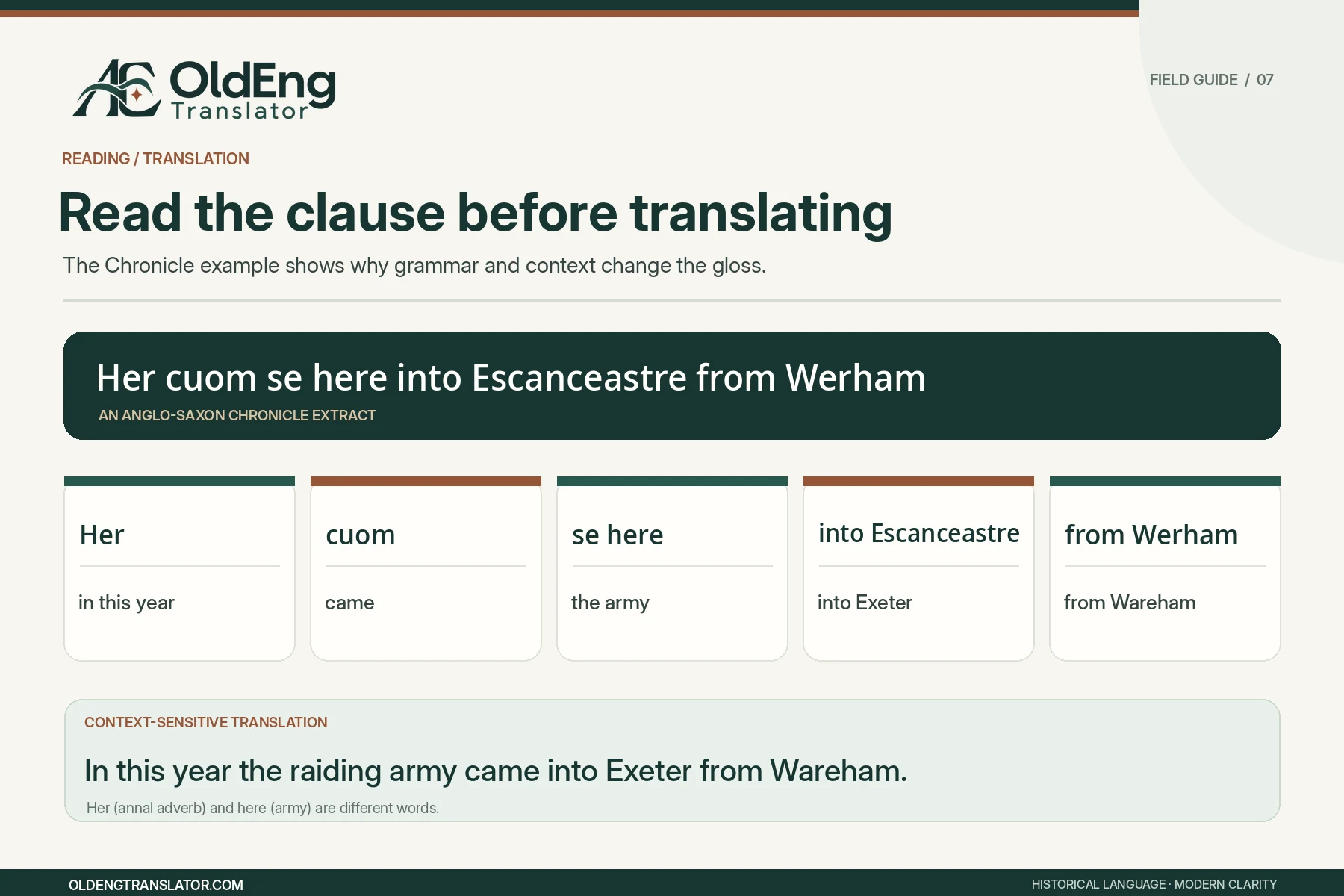
Her cuom se here into Escanceastre from Werham
The passage and its wider narrative are available in the Ashmolean Museum’s Anglo-Saxon Chronicle resource. The spelling above follows that displayed extract rather than being silently converted into the spelling of a beginner’s grammar book.
Here is the reading process in miniature:
| Text segment | Identification | Contribution to the meaning |
|---|---|---|
| Her | Opening adverb in a chronicle annal | “In this year†or “at this point in the record†|
| cuom | Past singular of cuman | “came†|
| se here | Masculine singular subject phrase | “the army,†contextually “the raiding army†|
| into Escanceastre | Prepositional phrase with a place-name | “into Exeter†|
| from Werham | Prepositional phrase with a place-name | “from Wareham†|
The first discovery is also the most instructive: **the two similar-looking forms Her and here do different jobs**. The first locates the event within a year-by-year account; the second identifies the group that moved. In this chronicle context, here commonly denotes a hostile or raiding force. Translating the opening as “Here came the here†would preserve a superficial resemblance at the expense of sense.
The second discovery is grammatical. The first words are an adverb followed by a verb, then the subject: Her cuom se here. Modern English normally puts the subject before the finite verb in a declarative sentence. The Old English order is perfectly interpretable once cuom is recognized as the verb and se here as the subject.
A rough structural gloss is “In-this-year / came / the-army / into-Exeter / from-Wareham.†A clear Modern English version rearranges that into “In this year the raiding army came into Exeter from Wareham.†We have changed the word order and explained the historical names, but we have not invented a new event.
Find the Verb and the Subject Before Translating the Details
A reliable first pass through Old English prose is to locate the finite verb: the form that anchors a clause in tense and often carries information about the subject. It might not resemble the infinitive listed in a dictionary.
In the Chronicle clause, cuom is a past singular form of cuman. Once you know it means “came,†the remaining words become easier to group. Se here answers who came; the phrases beginning into and from tell you the route. This is a more dependable approach than assuming that the first noun-looking form must be the subject.
A little farther along in the same Oxford extract is the clause 7 se sciphere sigelede west ymbutan. The 7-shaped sign represents “andâ€, not the number seven. Here se sciphere is the subject and sigelede means “sailed.†The compound sciphere refers to a ship-borne force, making the clause roughly “and the raiding fleet sailed around to the west.†The wider account describes separate land and sea forces; that context explains why translating both here and sciphere as the same undifferentiated “army†loses useful information.
These two clauses show why a reading method needs more than a vocabulary list. Identify the verb; group the subject; attach the prepositional and adverbial material; then decide how much the English wording must change.
Recover Dictionary Forms from the Words on the Page
Dictionaries normally organize words under headwords or lemmas, not under every grammatical form. This is one of the largest obstacles for a reader who knows a little vocabulary but has never translated a passage.
If you search only for cuom, you may miss the relevant entry under cuman. A past tense can change its stem vowel. A noun may have a case ending; an adjective may reflect the gender, number, and case of another word. Identifying those relationships can turn an apparently unknown word into a familiar one.
Try keeping two separate columns as you work:
| Form encountered | Likely headword | The question to ask |
|---|---|---|
| cuom | cuman, to come | Which tense and number does this form express? |
| stÄnum | stÄn, stone | Does the ending indicate dative plural? |
| bÄ“c | bÅc, book | Is the altered vowel identifying a plural? |
| þone | se (demonstrative paradigm) | Which noun does this accusative masculine form accompany? |
The forms in the last three rows are independent reference examples, not words taken from the Chronicle quotation. They show different reasons a direct lookup might fail. The noun and determiner patterns are explained more fully in our Old English Grammar guide; for translation, the practical skill is knowing when to consult a paradigm instead of guessing a new dictionary entry.
Be cautious with prefixes too. A verb beginning ge-, be-, or another prefix might require a search under the full prefixed form, not simply under the letters left after removing it. Prefixes sometimes affect meaning as well as form. Similarly, the written ending -um is a clue to investigate, not a guarantee of a particular interpretation without the rest of the phrase.
A good dictionary lookup records the candidate headword, its grammatical classification, the meanings that fit the passage, and any unresolved doubt. That small amount of annotation saves repeated searches and helps you explain why you chose a translation.
Choose the Meaning the Passage Supports
The first dictionary definition is not automatically the best translation. Words change meaning across genres and periods, and some Old English terms have several senses that modern English separates.
The Chronicle’s here is a useful example. As a noun it means an army or host; the surrounding military narrative makes “raiding army†an informative choice. By contrast, the initial Her belongs to the convention of yearly chronicle entries. It is a different word performing a different function, even though the two forms look similar in this transcription.
Context can also correct a misleading modern resemblance. Old English dēor can denote an animal or wild creature, not only the animal now called a deer. The verb sellan often means to give or hand over, not necessarily to sell for money. If your English draft introduces a payment absent from the original, you have allowed a modern sense to override the historical text.
Our Old English Words and Meanings reference collects such semantic distinctions. When translating a specific passage, however, the rule is more focused: compare candidate meanings with the subject, object, circumstances, and neighboring sentences. A sense that works in isolation may become implausible when placed back into the original.
Names and places also need judgment. Escanceastre is Exeter and Werham is Wareham in the Chronicle example. Giving familiar modern place names helps readers follow the history, but a scholarly transcription should still preserve the form used by the source. In a close study, showing both can be better than choosing only one.
Move from a Literal Gloss to Readable English
A useful translation often exists in three layers. They should not be confused with three competing answers of equal status.
1. Structural gloss. Keep the original sequence visible while identifying the words and relationships: “In-this-year / came / the-army / into-Exeter / from-Wareham.†This layer is a working aid, not polished prose.
2. Close translation. Express the grammar in coherent English without changing the meaning: “In this year the army came into Exeter from Wareham.†It retains much of the wording while putting the English subject and verb in a natural order.
3. Context-sensitive translation. Add a justified clarification where the historical setting supports it: “In this year the raiding army came into Exeter from Wareham.†Here “raiding†explains the here in this annal; it does not add an unrelated event.
A translator should be able to move among these layers. A close version can expose how an Old English clause is built, while a readable version serves someone who wants to understand the event. In difficult or disputed passages, a short note can preserve ambiguity rather than bury it under an overly confident English phrase.
There is no need to make every translation sound archaic. Rendering cuom as “did come forth†merely to create a medieval tone would be misleading if ordinary “came†expresses what the source says. Likewise, retaining every inversion in English can make a straightforward statement appear mysterious. Fidelity means preserving the relationships and sense, not copying the surface word order at all costs.
Handle Longer Prose Without Losing Track of Who Does What
Long Old English sentences often join clauses with and/ond, þÄ, relative constructions, or pronouns whose referents lie earlier in the passage. Translating every clause independently can obscure the narrative.
First mark the main verbs and clause boundaries. Then identify who each pronoun refers to. In accounts with several groups of people, an occurrence of hīe (“they†or “them,†depending on its function) may require you to look back to decide which force is acting. A modern translation may repeat a noun to remove uncertainty, but that clarification should be based on context, not invented because one interpretation feels smoother.
The word Ã¾Ä illustrates another hazard. It may function as a temporal expression such as “then,†while forms of the demonstrative can mean “the†in particular grammatical settings. Its position and surrounding words matter. Do not assign a single meaning wherever the letters occur.
Poetry requires a further adjustment. An Old English verse line can separate closely related words, use specialized poetic vocabulary, and depend on alliteration rather than the narrative flow expected in prose. Preserve the sense of the phrase before deciding how to render the poetic effect. The method described here is most immediately suited to short prose passages; it provides a foundation for poetry rather than a mechanical rule for translating it.
When a manuscript has damaged text, uncertain word division, or competing readings, distinguish the editor’s supplied reconstruction from what survives. You cannot make the underlying evidence more certain by producing fluent English.
Translating Modern English into Old English Is a Different Task
Reading an attested Old English passage means interpreting evidence that already exists. Translating a new Modern English sentence into Old English means composing something using historical vocabulary and grammar. That construction may be legitimate as an exercise without being an attested historical quotation.
Take a deliberately simple modern sentence:
Modern English: The ships came.
Constructed Old English: ÃžÄ scipu cÅmon.
Scip is a neuter noun whose nominative plural can be scipu. The plural demonstrative is þÄ, and cÅmon is a past plural form of cuman. The pieces agree, giving a defensible elementary Old English sentence. It is newly constructed for teaching; no claim is made that this complete wording occurs in a particular manuscript.
The exercise also shows why it would be unsafe to translate “The ships came†by choosing a random dictionary form for each word. You need a plural noun, an appropriate determiner, and a past-tense verb matching a plural subject.
For modern idioms, unfamiliar institutions, or contemporary technology, composition becomes substantially more uncertain. The aim should be to express the intended meaning in historically plausible terms, while making clear when the result is a paraphrase or reconstruction rather than preserved Anglo-Saxon language. A plausible phrase does not become historically attested simply because its grammar looks correct.
When a Translation Tool Gives an Unexpected Answer
An automated result is a starting hypothesis to test. If it disagrees with a scholarly translation or with the context, investigate the smallest point of disagreement instead of rejecting the whole sentence or accepting the tool without question.
| Unexpected result | Useful next check |
|---|---|
| A familiar-looking word has an odd meaning | Check older senses and its grammatical role. |
| A word is not found | Try the headword, historical spellings, and editorial letter substitutions. |
| Subject and object appear reversed | Look at the finite verb, determiners, and case forms. |
| A place name is treated as ordinary vocabulary | Check whether it is a historical name or inflected place-name. |
| The result is fluent but adds information | Compare it with a close gloss; separate clarification from invention. |
| Two editions seem to disagree | Compare their manuscript basis, normalization, and any editorial expansions. |
Keep the original beside the interpretation and mark uncertain words rather than silently smoothing over them. For exploring a first draft, the Old English Translator may be useful, but no automatic output can by itself establish that a proposed reading is historically secure.
A Short Practice Passage and a Reusable Translation Record
Return to the second clause of the Oxford Chronicle extract, printed here separately as a brief reading exercise:
7 se sciphere sigelede west ymbutan
Before looking at the answer, find the conjunction, the subject, the finite verb, and the direction of movement. Ask why the compound sciphere conveys something more specific than here alone.
Worked answer: The 7-shaped sign means “andâ€; se sciphere is the ship-borne army or raiding fleet; sigelede means “sailedâ€; west ymbutan indicates movement around to the west. A readable version is “and the raiding fleet sailed around to the west.†The English should not treat the sign as the numeral seven or read sciphere as a geographical “here.â€
For the next passage, keep a brief working record:
| Record | What to write down |
|---|---|
| Source | Title, passage reference, edition or manuscript where known |
| Exact wording | The Old English as printed, without silent corrections |
| Clause structure | Finite verbs, subjects, objects, and clause boundaries |
| Headwords | Likely dictionary entries for unfamiliar inflected forms |
| Alternatives | Competing senses or grammatical readings that remain possible |
| Final translation | Natural English plus a note for any consequential uncertainty |
You may not need to fill every field for a two-word phrase. With longer prose, the record helps you separate what the text visibly says, what its grammar supports, and what you infer from context. That distinction is the heart of reliable Old English translation. It lets a reader check the result and see exactly where another interpretation might differ.
Written by Arthur Westmer Editorial review: OldEngTranslator.com Editorial Team