Old English guide
Old English Alphabet: Letters, Special Characters, and How to Read Them
The Old English alphabet looks familiar until a word contains þ , ð , æ , or ƿ . Those four characters belonged to a writing system based mainly on the Latin alphabet, adapted for the language spoken and written in early medieval England. Anglo-Saxon scribes also used letter shapes and abbreviations that a modern printed edition may quietly replace.
To read Old English, it helps to separate three things: the letters used to write the language, the shapes those letters took in manuscripts, and the conventions modern editors use to make texts easier to read. A chart is the starting point, but knowing why Æ¿ might appear as w, or why gÅd carries a line above its vowel, is what makes the chart useful.
Old English Alphabet Chart
Most substantial surviving Old English prose and poetry was written with an adapted Latin alphabet. The following reference groups the letters commonly used for native Old English words; it is not a claim that every scribe followed one fixed 24-letter sequence. Medieval spelling varied by period, region, and manuscript.
| Common Latin-based letters | How they appear in a modern edition | Examples or reading notes |
|---|---|---|
| A a · E e · I i · O o · U u · Y y | a, e, i, o, u, y | All six function as vowel letters; y is not the English consonant sound heard at the start of yes. |
| B b · D d · L l · M m · N n · P p · R r · T t | b, d, l, m, n, p, r, t | Familiar basic letter values, although medieval handwritten shapes can differ. |
| C c · F f · G g · H h · S s · X x | c, f, g, h, s, x | Their use and sound values cannot always be read with Modern English spelling habits. |
For a quick one-line reference, a convenient modern arrangement of these frequently used signs is A Æ B C D à E F G H I L M N O P R S T Þ U Ç· X Y. It is a reader’s index, not a claim about one historical alphabetic order.
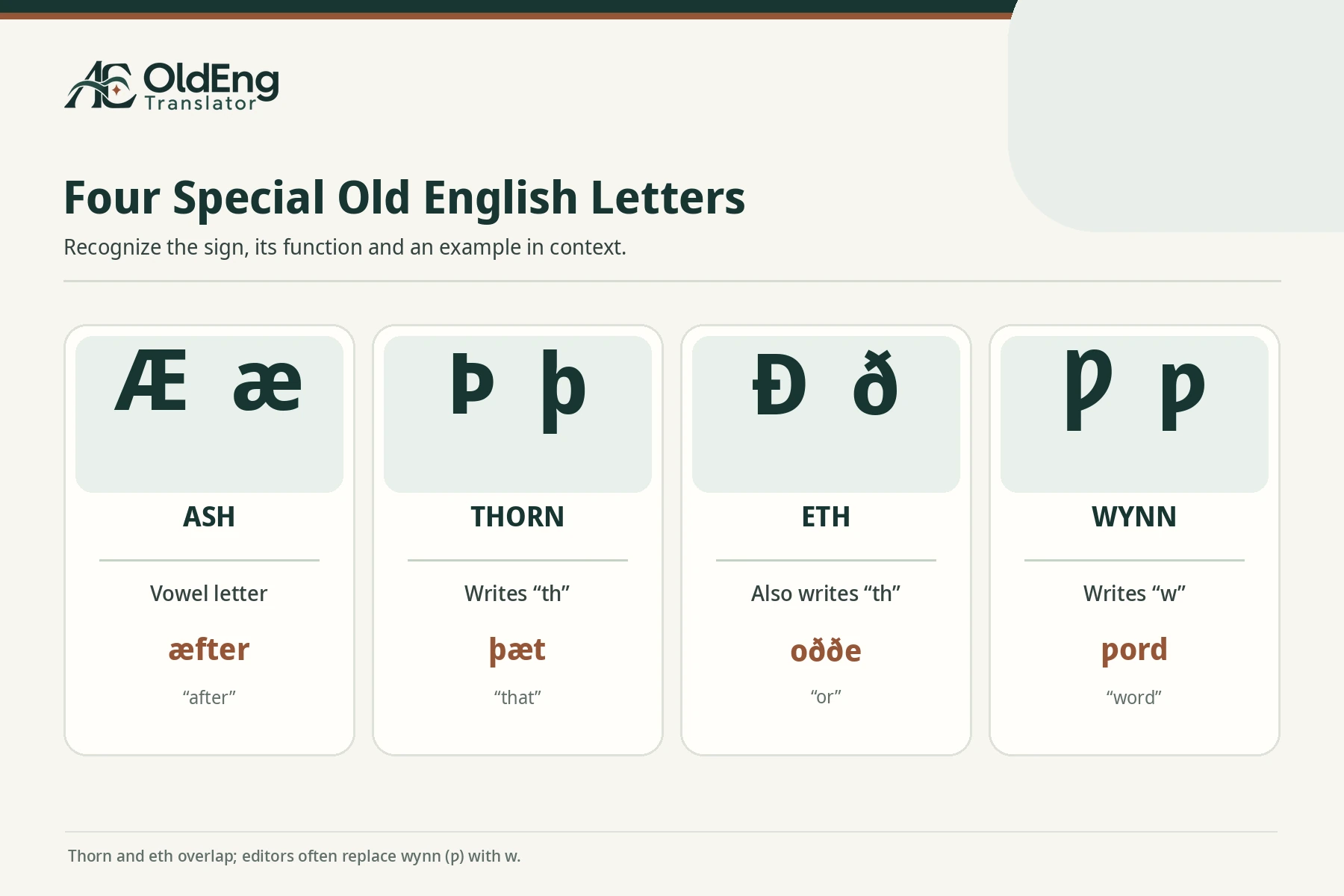
Four especially important characters are conventionally added to a beginner’s chart:
| Letter | Name | Main reading function | Example |
|---|---|---|---|
| Æ æ | Ash | A vowel letter distinct from a and e | æfter — after |
| Þ þ | Thorn | One way of writing the sound represented by modern th | þæt — that |
| à ð | Eth (edh) | Another way of writing th sounds | oððe — or |
| Ƿ ƿ | Wynn | Represents the sound written with modern w | ƿord, often printed word — word |
The Æ¿ord spelling illustrates the historical letter, not a quotation from a particular manuscript. Many teaching editions use w throughout, so their alphabet charts look different from a faithful transcription of the letterforms in an original page.
What About J, K, Q, V, W, and Z?
A modern A–Z list can give the wrong impression that Anglo-Saxon spelling operated just like present-day English.
J and V were not independent, regularly used letters for native Old English spelling. The sound now written j in certain modern words did not require a separate letter j, and v was not used as a distinct native letter in the modern way. The letter f could represent a sound resembling modern v in some positions, but that did not require scribes to write v.
K, Q, and Z were uncommon in native words, although letters could occur in Latin, names, or unusual spellings. Old English normally used c where modern English might use k, and a spelling such as cwēn (queen) helps explain why modern qu should not be projected backward automatically.
W needs a historical qualification. The sound was certainly present, but the character Æ¿ (wynn) was widely used to write it. A modern edition’s w may be a substitution for that older sign, not evidence that the manuscript itself used the modern letterform.
There is consequently no single universally applicable answer to “How many letters were in the Old English alphabet?†A count depends on whether one includes infrequent Latin letters, regional practices, manuscript variants, and editorial substitutions. The chart above is a working reference for reading the language, not an invented official medieval alphabet.
The Four Special Letters Explained
Thorn (þ) and Eth (ð): Two Ways to Write th
Thorn and eth could both represent the consonant sounds that Modern English writes as th in thin and this. They were not assigned a stable, universal one-letter-per-sound rule across Old English manuscripts. A scribe’s preference, period, and word position could affect which appeared.
Thorn was borrowed into the Latin-based writing system from the Anglo-Saxon runic tradition. Eth was formed by modifying the Latin letter d. In many later Old English sources the two are interchangeable, sometimes even within the same text.
This matters when searching for a word. A form printed with þ in one edition may appear with ð in another. Replacing every thorn with t, or reading eth as d, changes the text incorrectly. In a normalized transcription, both usually remain identifiable as Old English letters even if an editor chooses one form consistently.
Ash (æ): A Letter, Not Two Separate Vowels
Ash resembles an a joined to an e. In Old English it functions as its own vowel letter, as in æfter (after) and dæg (day). It should not be treated as two consecutive letters that happen to touch on the page.
Editors may also write ǣ, an ash with a macron, to signal a historically long vowel. The mark describes vowel length in a modern scholarly convention; it does not make ǣ a separate member of the medieval alphabet.
Wynn (Æ¿): The Letter Modern Editions Often Hide
Wynn represents w. Its lowercase form, Æ¿, can resemble a p, especially when the reader is unfamiliar with medieval handwriting. Mistaking it for p can turn an ordinary word into something unrecognizable.
Many editors print w where manuscripts show wynn. That is a useful modernization of the lettering, provided readers recognize the substitution. It does not change the word’s meaning or turn Old English into Modern English.
Familiar Letters That Can Mislead Modern Readers
Not all the challenges involve unusual characters. Some ordinary-looking letters represent sounds differently from their closest Modern English equivalents.
| Old English spelling | Word and meaning | Why it matters |
|---|---|---|
| c | cild — child; cyning — king | The letter could represent different consonant values depending on its linguistic environment. |
| g | gēar — year | A modern editor may add a dot, ġ, when explaining a palatal sound; that dot is editorial. |
| sc | scip — ship | This pair normally corresponds to the sound written sh in the modern word. |
| cg | ecg — edge | The spelling represents a consonant combination that developed differently from what modern c plus g might suggest. |
| h | niht — night | The letter could represent a pronounced consonant where its modern descendant has a silent gh. |
| y | cyning — king | Here y is a vowel letter, not the sound at the beginning of modern yes. |
These are reading clues, not a complete pronunciation key. Some values depend on neighboring sounds, dialect, or period, and scholarship reconstructs pronunciation from indirect evidence rather than recordings. The important habit is to read a word as Old English first, not apply Modern English letter rules automatically.
Even the spelling sc should not be treated as a universal mechanical replacement for modern sh. A reader still needs the actual word and context, particularly when dealing with mixed-language manuscripts or names.
Long Vowels, Diphthongs, and Editorial Marks
A beginner may find two printed versions of what appears to be the same word: god and gÅd. In modern normalized spelling, the first can mean God or deity, while gÅd means good. The macron above Å tells the reader that the vowel is historically long; it can distinguish words that otherwise look identical.
Modern Old English learning materials commonly use macrons with Ä, Ç£, Ä“, Ä«, Å, Å«, and ȳ. They may also mark long vowel combinations such as Ä“a and Ä“o. The underlying Old English spelling conventions were more varied. Do not assume a medieval scribe systematically marked every long vowel with a macron.
A different editorial mark is the dot over Ä‹ or Ä¡. It tells the modern reader that a particular sound value is intended. For instance, Ä‹Ä“osan (choose) and Ä¡Ä“ar (year) may be printed with dots in teaching resources, even though those precise dots are not an obligatory feature of manuscript spelling.
Old English also used vowel combinations such as ea and eo. These are important for understanding spelling and sound patterns, but the presence of two letters does not always mean the vowels were pronounced as two independent modern syllables. A detailed treatment belongs to the language’s pronunciation system rather than to a letter chart.
For reading purposes, identify whether a mark belongs to the manuscript or has been supplied by the editor. That single question prevents a surprising number of mistakes when comparing a digitized manuscript with a printed glossary.
Manuscript Letterforms and Signs That Are Not Alphabet Letters
Old English texts were copied by hand. The scripts used for them included Insular forms inherited from early medieval writing traditions, and the shapes of familiar letters did not always resemble the forms in a modern font.
An Insular g (áµ¹) is a good example. It is a historical shape of g; printed editions usually replace it with g. It is related in the history of writing to the later letter yogh (È), but the two should not be treated as interchangeable names for the same letter in every period. Yogh developed into a distinct written character during Middle English.
Another potential surprise is long s (Å¿). This is a shape of s, not an f, even if it initially resembles one. Other lowercase letters, including r and d, could also take unfamiliar handwritten forms.
Scribes used abbreviations as well as letters. Two particularly useful signs are:
| Manuscript sign | Read or expanded as | What it is |
|---|---|---|
| ⊠| and or ond — and | Tironian et, an abbreviation sign resembling a 7, not the numeral seven. |
| ê¥ | þæt — that | A crossed-thorn abbreviation for the word þæt, not an additional alphabet letter. |
These forms explain why reading an Old English manuscript involves more than recognizing the alphabet. A modern editor may expand an abbreviation, replace a medieval shape, and insert explanatory vowel marks before a student ever sees the text.
For a well-illustrated scholarly account of Insular letterforms and these abbreviations, see the University of Zurich’s *Ad fontes* guide to Insular scripts.
Do Old English Letters and Anglo-Saxon Runes Form One Alphabet?
No. The Latin-based system described here and the Anglo-Saxon futhorc are related parts of Old English writing history, but they are distinct scripts. Runes were used for inscriptions, while the bulk of surviving longer literary and documentary writing uses adaptations of the Latin alphabet. Thorn and wynn entered the latter from the runic tradition.
Writing a word in runic signs changes its script; it does not by itself translate the word into a different language. A proper account of the futhorc requires its own inscriptions, characters, and historical setting.
From a Manuscript Sign to a Word You Can Read
A reader may see three versions of the same material: a manuscript-like sign, a normalized spelling, and an English interpretation. These stages answer different questions. The first preserves a historical graphic form; the second makes a text easier to search or compare; the third explains meaning.
The examples below are isolated teaching demonstrations, not transcriptions claimed to come from one particular manuscript:
| Manuscript-style sign or spelling | Modern edited form | Meaning or function | What changed? |
|---|---|---|---|
| Æ¿ord | word | word | Wynn was represented with w. |
| ᵹear | gēar | year | Insular g became g; vowel length was marked editorially. |
| ⊠| and | and | An abbreviation was expanded. |
| ê¥ | þæt | that | An abbreviation was expanded to a word. |
| ðæt | þæt | that | A different permitted spelling of the th consonant was normalized. |
The first and second columns are not necessarily identical in historical detail. A transcription intended to record a specific manuscript accurately may preserve Æ¿, áµ¹, and abbreviations, while a reading edition may regularize them. Neither editorial choice should be confused with translating Old English into Modern English.
This distinction helps when copying a word for a dictionary search. If a search finds nothing for Æ¿ord, looking under word is sensible. If it finds nothing for áµ¹ear, converting the letterform to g is a reasonable step. A reader still needs to check spelling variants and the surrounding passage before deciding what an unfamiliar word means.
Copying and Typing Old English Characters
You do not need to replace special characters with unrelated symbols. Most current devices can display thorn, eth, and ash, and many fonts also support wynn and specialist editorial signs.
Common Old English characters to copy:
Æ æ · Þ þ · à ð · Ƿ ƿ
Common editorial vowel marks to copy:
Ä€ Ä Â· Ç¢ Ç£ · Ä’ Ä“ · Ī Ä« · ÅŒ Š· Ū Å« · Ȳ ȳ
For practical input, you can copy the needed character directly from this page. If it appears as an empty square, the likely problem is font support rather than a missing historical letter. Changing to a font with wider Unicode coverage may help.
Keep the original spelling when quoting a scholarly edition or a historical passage. For casual word lookup, a normalized form may be more convenient, but do not silently change a quotation. In particular, do not substitute p for wynn or treat ð as d. Those changes can produce a different word or a meaningless form.
When examining a phrase, isolate one unfamiliar sign at a time: identify its letterform, decide whether it represents a letter or abbreviation, and only then consult a dictionary. You can explore word meanings using the Old English Translator, while checking uncertain historical readings against the context and a reliable source.
A reader who can recognize æ, þ, ð, Æ¿, spot common editorial marks, and distinguish a manuscript form from a normalized spelling has already overcome the largest visual obstacles to beginning Old English. The language’s grammar and vocabulary still require study, but its written surface becomes far less mysterious.
For the historical setting in which this writing system developed, read What Is Old English?.
Written by Arthur Westmer Editorial review: OldEngTranslator.com Editorial Team