Old English guide
Old English Pronunciation: Vowels, Consonants, Stress, and Spoken Examples
An Old English word can look familiar and still sound quite unlike its Modern English descendant. HÅ«s became house , but the Old English vowel was closer to the sound in modern goose than to the vowel in house . Cniht became knight , although the beginning of the older word included a pronounced c and its h represented a consonant now lost from ordinary English speech.
Old English pronunciation is reconstructed, not recorded. No one can listen to an Anglo-Saxon speaker, and there was no single accent shared by every community across the entire Old English period. Yet spelling, poetry, related Germanic languages, and later sound changes provide enough evidence to make a historically informed reading possible. The aim is to learn the principal sound distinctions without pretending that every detail is settled.
How Do We Know What Old English Sounded Like?
Written Old English gives clues, but a letter on a manuscript page is not a sound recording. Scholars compare several kinds of evidence.
Spelling patterns show which distinctions scribes considered worth representing. Words written with f in different positions, for instance, help explain why the same letter could have a voiceless or voiced pronunciation. Differences among early manuscripts also reveal regional variation, although spelling alone cannot tell us exactly how a person moved their tongue or lips.
Old English poetry provides another line of evidence. Alliteration depends on the prominence of particular sounds at stressed positions. Its patterns can help identify stress and sometimes support conclusions about how words began. Comparisons with Old Frisian, Old Saxon, Old High German, and later English forms add information about how inherited sounds developed.
This evidence supports broad reconstructions more securely than minute phonetic details. Some pronunciation handbooks give slightly different vowel symbols or diphthong values, even when they agree about the main contrasts. The University of Glasgow’s *Essentials of Old English* is a useful scholarly introduction that explicitly recognizes this uncertainty.
The examples below use normalized spelling for learning. They are broadly oriented toward commonly taught West Saxon forms, not a reconstruction of every Old English dialect or century. If you first want to understand when the language was spoken and why its written varieties differed, see What Is Old English?.
The Old English Vowels: Short and Long Are Different Sounds
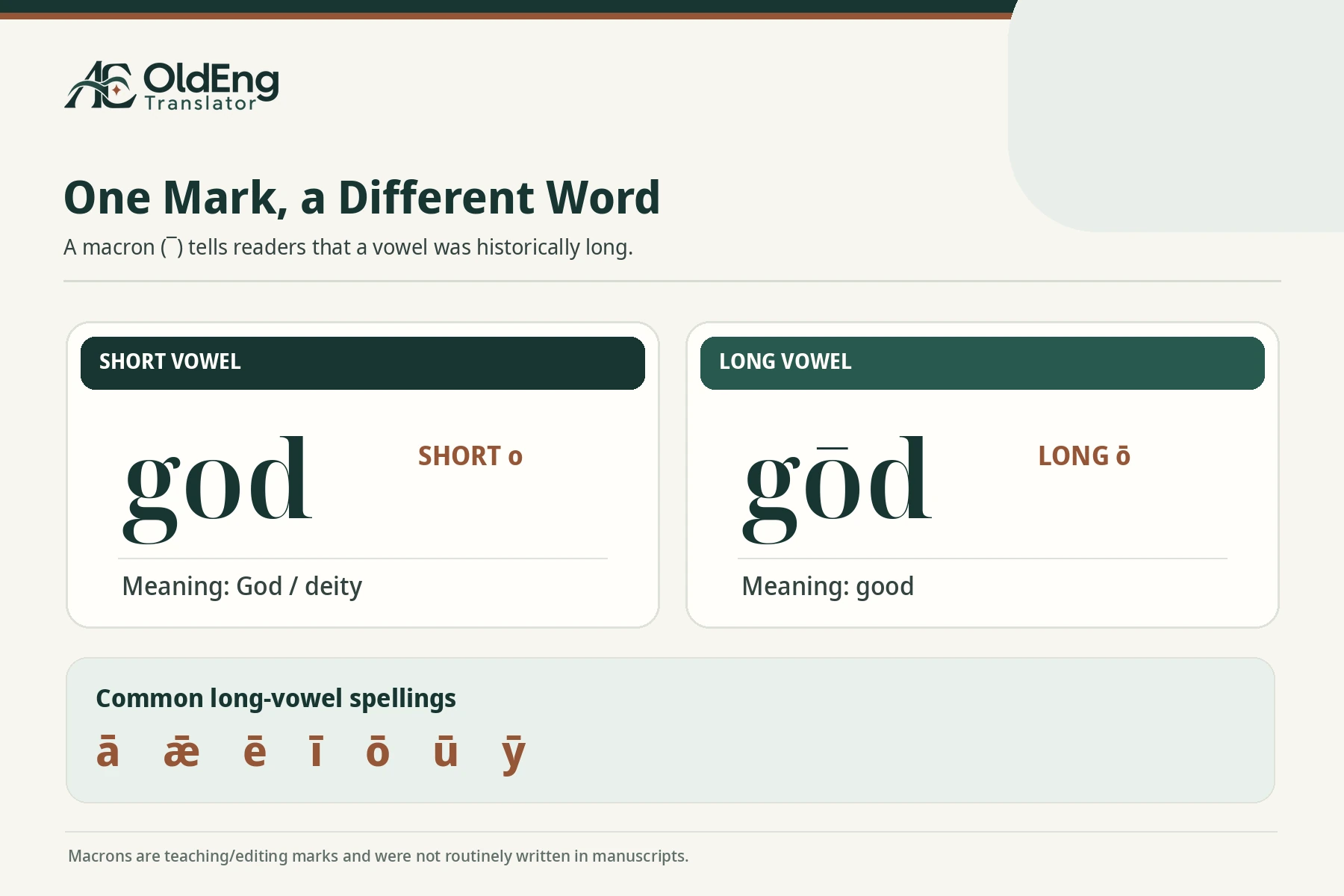
Old English distinguished vowel length in a way that could change a word’s meaning. In modern teaching editions, a line above a vowel, called a macron, usually marks a long vowel. The mark is an editorial aid; it was not systematically added to long vowels in original manuscripts.
Compare god (God or deity) with gÅd (good). In a normalized reading they differ in vowel length. Treating the macron as decoration would erase a meaningful contrast.
The principal simple-vowel spellings can be organized in seven short–long pairs:
| Short and long spellings | General pronunciation target | Old English example |
|---|---|---|
| a / Ä | An open, unrounded vowel, held longer for Ä; not modern English ay | nama (name), stÄn (stone) |
| æ / ǣ | A front, open vowel, roughly the vowel in some pronunciations of cat; length matters | dæg (day), ǣr (before) |
| e / ē | A front vowel, without automatically adding the modern ay glide | helpan (help), mē (me) |
| i / ī | A high, front vowel, comparable in broad position to the vowel in machine | sittan (sit), wīf (woman, wife) |
| o / Å | A rounded back vowel; the long version should not be turned into modern English oh with an exaggerated glide | god (God), gÅd (good) |
| u / ū | A high, rounded back vowel, broadly like the vowel in goose | sunu (son), hūs (house) |
| y / ȳ | A high, front rounded vowel absent from most present-day English accents | cynn (kin, family), cȳþþ (acquaintance, kinship) |
These are practical targets, not seven precisely measured pairs of sounds. Scholars vary in the exact qualities assigned to some short vowels, particularly when describing different periods. What matters first is keeping the historically significant distinctions rather than reading the spellings as though they were Modern English.
How to Make the Unfamiliar y Sound
The letter y in cynn is a vowel. It does not sound like the consonant beginning modern yes, nor should it automatically be pronounced as the y in my.
Start by making an ee sound, keeping your tongue in approximately the same forward position. While sustaining it, round your lips as if preparing to say oo. The resulting front rounded vowel is close to French u in tu or German ü. For ȳ, sustain that quality longer.
Regional and later Old English forms did not always preserve this vowel identically, so a normalized spelling with y is a good guide to the teaching pronunciation, not proof that every historical speaker produced exactly the same sound.
Why Vowel Length Matters More Than a Modern English Rhyme
The familiar schoolroom labels long a and long i are misleading here. In Modern English, a “long i†often refers to the changing vowel heard in time. Old English ī did not mean that modern sound; it was broadly a sustained ee-like vowel. Similarly, ū in hūs was closer to oo than to the modern sound of ou in house.
A useful exercise is to say a short vowel, then hold the same general tongue and lip position for longer. Do not automatically convert it into a modern diphthong. The difference between god and gÅd is a better reminder than an English spelling analogy.
How to Pronounce ea, eo, and Other Vowel Combinations
Some Old English vowel spellings represent diphthongs, in which the tongue moves between vowel qualities within a single syllable. They are not normally two separately stressed vowels, nor can they be reliably read using the values of modern English ea in meat or bread.
| Written combination | Examples | What to attempt when reading |
|---|---|---|
| ea | eald (old) | A short glide beginning with a front, open vowel and moving toward a more back or open position |
| ēa | lēaf (leaf) | A longer version of a related glide |
| eo | heofon (heaven) | A glide from a front vowel toward a rounded, back quality |
| ēo | dēor (animal, wild beast) | A longer counterpart to eo |
The exact phonetic interpretation of these spellings is debated, particularly across periods and dialects. Some descriptions give detailed phonetic transcriptions; others favor a simplified classroom pronunciation. Neither should be mistaken for a surviving recording.
You may also encounter ie / īe in certain West Saxon descriptions, as in forms of the verb hīeran (to hear). This is not a uniform feature of every dialect, and its historical sound value is especially uncertain. Readers should not turn it into a fixed universal rule for all Old English.
For beginners, the useful distinction is between a single simple vowel, a gliding vowel, and two vowels belonging to separate syllables. The spelling alone can suggest a category, but the word, dialect, and edition matter.
Consonants That Change Their Sound with Position
Several ordinary-looking letters are less predictable than their Modern English counterparts. A particularly important distinction is between velar sounds, made toward the back of the mouth, and palatal sounds, made farther forward.
| Spelling or sign | Typical sound in relevant contexts | Example |
|---|---|---|
| c | /k/ as in king | cyning (king) |
| ċ (editorial dotted c) | /tʃ/ as in church | ċild (child) |
| g | /g/ as in go, or a softer fricative in certain positions | gÄr (spear), dragan (to drag) |
| Ä¡ (editorial dotted g) | /j/ as in the first sound of yes | Ä¡Ä“ar (year) |
| sc | Commonly /ʃ/ as in ship | scip (ship) |
| cg | Commonly /dÊ’/ as in edge | ecg (edge, sword-edge) |
| h | /h/ at the beginning of a word; a throat or palate fricative in certain later positions | hūs (house), niht (night) |
The dots above Ä‹ and Ä¡ are modern teaching conventions. Medieval scribes did not consistently mark the distinction in this way. More importantly, a following front vowel is not a foolproof pronunciation rule. Cyning begins with /k/ even though y is a front vowel. The history of a word as well as its spelling can determine which sound is appropriate.
The sound associated with medial g in forms such as dragan is often reconstructed as a voiced fricative, somewhat like a Dutch g in certain pronunciations. Beginners need not imitate it perfectly to recognize that the letter did not invariably sound like the modern hard g.
Thorn and Eth Do Not Mean Two Different th Sounds
Old English used þ (thorn) and ð (eth) for the consonant sounds that modern English generally writes th. These sounds include /θ/ in thin and /ð/ in this.
The crucial point is that the letter chosen does not consistently tell you which pronunciation to use. Both characters were used for both sounds. In broad accounts of Old English, a single th consonant near the beginning or end of a word is often voiceless, while one between voiced sounds is commonly voiced. Actual forms and historical variation still matter.
The same positional pattern helps explain why f could be pronounced like modern f in fisc (fish) but like /v/ in ofer (over). Similarly, a single s between voiced sounds was often pronounced /z/, even though the writing retained s. These are useful historical patterns, not permissions to replace every written f with v or every s with z.
Sounds Modern English Often Leaves Silent
A modern reader of knight is accustomed to ignoring the initial k and written gh. In Old English cniht, the initial c was pronounced /k/, and the h represented a consonant pronounced at the back of the mouth or farther forward according to its surroundings. The exact sound is often compared with the consonant in Scots loch or German ich.
Other clusters could retain sounds that later disappeared or changed. The w at the beginning of wrītan (to write) was pronounced. The g in combinations such as ng could also be heard as a stop following the nasal, unlike the ending of many present-day English words in -ing.
It is therefore better to say that Old English generally preserved more of the consonants indicated by its spelling, while recognizing that groups such as sc and cg could represent single complex sounds. “Pronounce every letter separately†would be an inaccurate rule.
Stress, Double Consonants, and Unstressed Endings
Old English word stress generally fell on the first syllable of the root. In a simple word, that often means the first syllable: SUN-ne, MŌ-dor, STAN-dan. Many grammatical endings did not carry the main stress.
A prefix changes the calculation. Common verbal prefixes such as ge- and be- were generally unstressed, so in a form such as gesittan the prominence belongs to the root rather than the opening prefix. Other prefixes and word classes require their own analysis. The rule is root stress, not “always emphasize the first written syllable.â€
The vowels of unstressed syllables were also typically more distinctly articulated than the heavily reduced vowels of many Modern English accents. A final written -e is therefore not automatically silent. Sunne (sun), for example, has two syllables; pronouncing it as modern one-syllable sun loses information about the older form.
Old English also distinguished single and double consonants. In biddan (to ask or pray), the written dd represented a longer consonant than a single d would. Think of holding the consonant across a syllable boundary rather than inserting a new vowel or saying the letter’s name twice. This duration difference is characteristic of languages such as Italian today but is easy for Modern English speakers to overlook.
These three features work together: stress identifies the prominent root, vowels help preserve the syllable structure, and consonant length may affect the audible division between syllables.
A Complete Old English Sentence to Pronounce
Here is a constructed teaching sentence, not a quotation from an Anglo-Saxon manuscript:
Old English: SÄ“o sunne is hÄt. Modern English: The sun is hot.
Rather than memorizing an English-style respelling of the whole line, read it in stages:
- SÄ“o begins with a long gliding vowel written Ä“o. It is the feminine singular subject determiner accompanying sunne.
- Sunne has two syllables, with main stress on sun- and a sustained nn across the syllable boundary. The ending is audible.
- Is is a short, straightforward word, with a vowel and final s; it need not receive the sentence’s strongest emphasis.
- HÄt begins with an audible h and contains a long Ä, broadly an open ah-like vowel held longer than the short counterpart. Do not pronounce it with the vowel of modern hate.
Say the words separately, then combine them without suppressing the end of sunne or changing hÄt into the modern word hate. That is a more defensible reading exercise than pretending to know the exact pitch, pace, or regional accent of the historical speaker.
Pronunciation Practice with Ten Common Words
This compact practice set groups different sound problems. The English glosses identify the words; they are not pronunciation instructions.
| Old English | Meaning | What to listen for or practice |
|---|---|---|
| stÄn | stone | Sustain the open Ä rather than using the modern vowel of stone. |
| hūs | house | Read ū as a long, rounded vowel, not modern ou. |
| god | God, deity | Keep the vowel short. |
| gÅd | good | Hold Å longer than the vowel in god. |
| cynn | kin, family | Form the front rounded y. |
| scip | ship | Use the sh sound for sc in this word. |
| Ä‹ild | child | The dotted editorial Ä‹ signals a ch sound. |
| Ä¡Ä“ar | year | The dotted editorial Ä¡ signals a consonant like modern initial y. |
| ofer | over | The single f between voiced sounds is typically voiced like v. |
| niht | night | Give h a historical fricative value rather than making it silent. |
A good first pass is not to aim for theatrical fluency. Read slowly enough that the vowel-length contrasts, special consonant values, and syllable boundaries remain audible. Then repeat the words in a more natural rhythm.
Why Modern Descendants Can Mislead Your Ear
Using modern words as memory aids has limits because English sounds continued changing for centuries after the Old English period.
- HÅ«s became house, but its former long Å« developed into a different vowel sound.
- StÄn became stone, with a substantial change in vowel quality.
- Cniht became knight, losing the pronunciation of letters retained in modern spelling.
- GÅd became good, but the modern vowel does not simply reproduce the historical long Å.
These outcomes did not all happen at once or through one sound change. The later history of English includes multiple vowel shifts, consonant losses, regional developments, and spelling conventions that outlasted the sounds they once represented.
For this reason, a resemblance between an Old English word and a modern descendant helps identify historical relationships, not necessarily its historical pronunciation. The spelling may preserve the past, the present, or a mixture of conventions established at different times.
How to Read an Unfamiliar Passage Aloud Responsibly
Start with a trustworthy edited text and identify its spelling conventions. If the edition supplies macrons or dots over c and g, find out what they mean; if it preserves regional manuscript spellings, do not assume they follow the normalized West Saxon forms used in beginner handbooks. The Old English Alphabet guide explains the difference between manuscript letterforms, normalized spelling, and editorial signs.
Then find the prominent roots and mark their stress. Separate the word into audible syllables, paying attention to final vowels and doubled consonants. Work through vowels before tackling the more troublesome consonants: a clearly sustained Ä, Å, or Å« will often improve a reading more than an uncertain attempt at a rare sound.
Read a short phrase aloud, listen for whether you have accidentally imported Modern English habits, and adjust one feature at a time. An unfamiliar form may need to be checked against a dictionary or grammatical reference before its pronunciation can be judged confidently. You can use the Old English Translator to explore a word’s meaning, but translation and reconstructed pronunciation answer different questions.
Finally, keep the uncertainty in view. Regional forms such as Northumbrian and West Saxon did not necessarily sound identical, and the language evolved over centuries. Even within one variety, detailed reconstructions can differ between specialists. A careful, consistent reading is a useful learning goal; a claim to reproduce the one authentic Anglo-Saxon accent is not.
Written by Arthur Westmer Editorial review: OldEngTranslator.com Editorial Team