What Is Old English? History, Origins, and Real Examples
Old English is the earliest recorded form of the English language. It was used in early medieval England long before the English of Chaucer or Shakespeare, and its surviving writing can look unfamiliar even to someone who speaks Modern English fluently. Consider hūs, which resembles house, beside scylun, a word that most readers would not recognize without help. Both belong to the history of English.
Usually dated from around the fifth century to the late eleventh or early twelfth century, Old English developed from related West Germanic varieties spoken by people who settled in Britain. It was the language of ordinary conversation as well as laws, poetry, sermons, historical writing, and other records. Its history explains both why so much of today’s everyday vocabulary is recognizably Germanic and why an original Old English passage is difficult to read without study.
Where Did Old English Come From?
The language took shape in Britain after groups from areas around the North Sea began settling there during the fifth century. Historical accounts commonly identify the Angles, Saxons, and Jutes, although the formation of early English-speaking communities was a gradual process, not the arrival of one people speaking a single, standardized language.
The newcomers spoke related West Germanic varieties. These belonged to the same broad branch of the Germanic language family as the ancestors of Frisian, Dutch, and German. As communities became established across parts of Britain, their speech developed into the regional forms that scholars collectively call Old English.
Britain was already multilingual. Brittonic Celtic languages and Latin were present before these settlements; they did not immediately disappear. Contact with other populations, conversion to Christianity, and trade brought further linguistic influences. Latin became especially important in religion, education, and the written culture of the Church. Later, contact with Scandinavian settlers speaking Old Norse also affected English, particularly in northern and eastern regions.
Old English did not begin as Modern English spoken with different vocabulary. It was an earlier historical stage of the same language, with its own sounds, grammatical system, and regional traditions.
Why Is Old English Also Called Anglo-Saxon?
Anglo-Saxon is a historical label associated with the peoples and kingdoms of early medieval England. It is also used as a name for their language. Old English is the more precise term when discussing the linguistic stage that preceded Middle English.
Speakers and writers of the period could refer to their language as Englisc. The modern labels help distinguish that language from the later forms of English familiar to present-day readers.
When Was Old English Spoken?
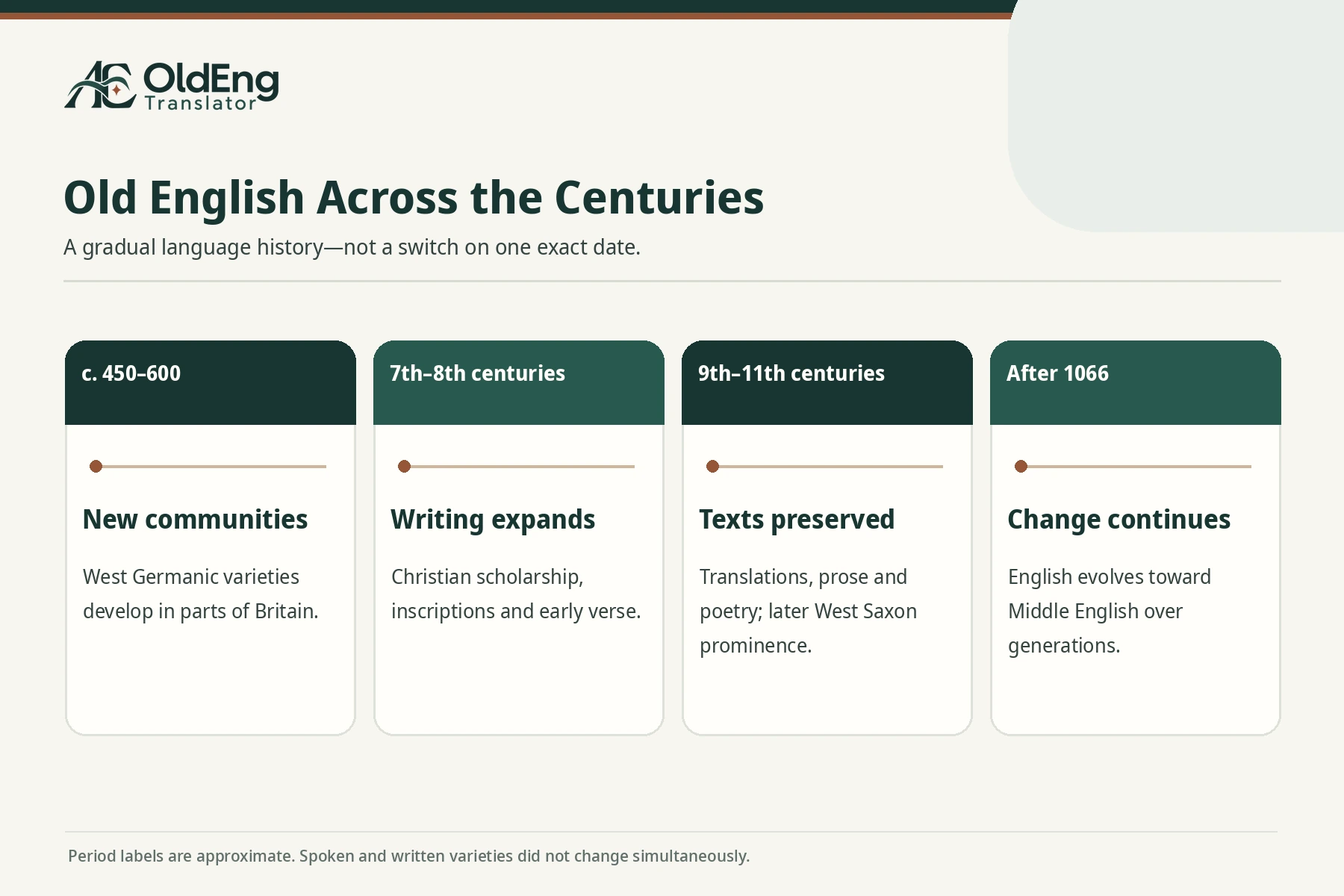
There is no single day on which Old English began or ended. The usual dates describe a long period of linguistic development, not sharp boundaries recognized by its speakers.
| Approximate period | What mattered for the language |
|---|---|
| Fifth and sixth centuries | West Germanic-speaking communities became established in parts of Britain; the varieties that developed there form the beginnings of Old English. |
| Seventh and eighth centuries | Christian scholarship and Latin writing expanded; early Old English inscriptions and verse provide evidence of the language. |
| Ninth century | Scandinavian contact increased, and the reign of Alfred of Wessex encouraged learning and translation into English. |
| Tenth and eleventh centuries | A substantial body of Old English prose and poetry was copied and preserved; later West Saxon forms became prominent in written literature. |
| After 1066 and into the twelfth century | Norman French gained prestige in government and elite society, while spoken English continued to develop into forms classified as Middle English. |
For that reason, some histories use a range such as c. 450–1100, while others extend the Old English period to approximately 1150. These are scholarly conventions rather than contradictory claims about a sudden change.
The Norman Conquest of 1066 was historically decisive, but it did not cause English to vanish overnight. People continued speaking English; changes already underway in pronunciation, grammar, vocabulary, and writing continued across generations.
What Did Old English Actually Look Like?
One of the most revealing examples comes from Cædmon’s Hymn, an early English religious poem associated with a seventh-century poet described by Bede. A Northumbrian version survives in an eighth-century manuscript.
The opening words in the version preserved in the Moore Bede manuscript read:
Nu scylun hergan hefaenricaes uard
A close Modern English rendering is: “Now we must praise the guardian of heaven’s kingdom.”
This is an attested historical line, not a newly invented practice sentence. The manuscript reading and its context can be examined in the University of Toronto’s edition of Cædmon’s Hymn.
A few details reveal how different early English could be:
- Nu corresponds closely to modern now.
- scylun is an early form expressing an obligation or expectation, rendered here as must.
- hergan means to praise.
- hefaenricaes contains the idea of heaven’s kingdom in a possessive form.
- uard means guardian or protector; its initial spelling differs from the familiar modern w.
The spelling is Northumbrian. It should not be silently treated as the one universal way Old English was written. Other manuscript traditions preserve different forms of the hymn, making this short line evidence of both the language and its regional diversity.
A Poem’s Age and a Manuscript’s Age Are Not the Same
A text may have been composed, circulated orally, and copied long before the particular manuscript that survives today was made. The surviving copy tells us directly about the words written by its scribe; the date of the original composition may require separate historical and literary arguments.
This distinction is essential when assessing claims about the “oldest English poem” or the precise age of a well-known literary work. The survival of a manuscript is not the same thing as the birth of the language, or necessarily the moment a poem was first composed.
How Was Old English Different from Modern English?
The difference was deeper than spelling. An Old English speaker used a grammatical system in which the forms of nouns, pronouns, adjectives, and verbs carried information that Modern English often expresses through word order and separate words.
For instance, the noun stān means stone. The related form stānas means stones, while stānes can express a singular genitive relationship, such as of a stone. The endings contribute grammatical information; they are not merely alternative spellings.
Old English also distinguished three grammatical genders and normally described nouns through four principal cases: nominative, accusative, genitive, and dative. The gender of a noun was a feature of its grammar, not necessarily a statement about the object it named. Verbs varied according to categories including tense, person, number, and mood.
As a result, Old English allowed patterns of word order that can sound unusual when transferred directly into Modern English. Readers need to interpret the forms and their relationships, rather than replace every word independently.
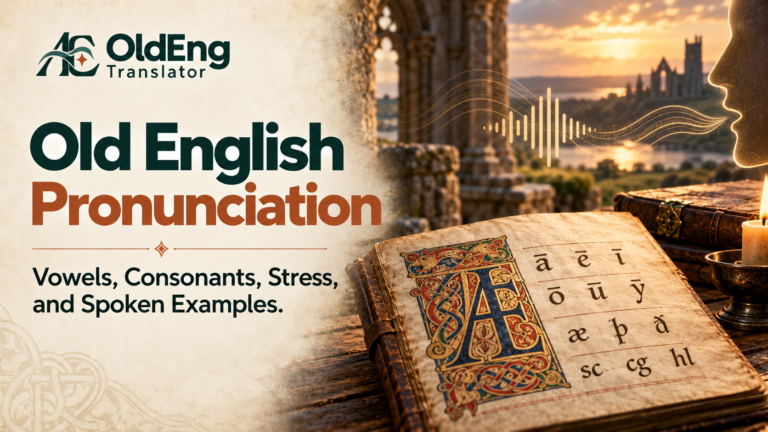
Its sound system differed as well. The spellings þ, ð, æ, and ƿ may stand out to a modern reader, but the less visible distinctions are just as important: vowels that later changed in quality or length, consonants pronounced differently from their modern descendants, and stress patterns that shaped how words developed.
These features explain why knowing the modern descendant of an Old English word does not automatically make a whole sentence understandable. The detailed rules belong to grammar and pronunciation study; here, the important point is that Old English was a complete, functioning language, not a collection of antique words.
Old English Words That Still Resemble Modern English
Some common English words have changed surprisingly little in their written form or basic meaning. Others look familiar but have narrowed or shifted in meaning.
| Old English | Modern English connection | What the comparison shows |
|---|---|---|
| hūs | house | A recognizable native word with later spelling and sound changes |
| bōc | book | A common word carried forward from Old English |
| stān | stone | A related word whose vowel developed differently |
| niht | night | The spelling preserves a consonant later lost from ordinary pronunciation |
| mete | meat | In Old English, mete could mean food more generally, not only animal flesh |
The long-vowel marks in forms such as hūs and stān are conventional aids in modern editions; they were not consistently written by medieval scribes.
The last example is particularly useful. A present-day reader may see mete and think specifically of meat, yet historical evidence supports the broader meaning food. Related words can remain in use while their meanings change.
Old English has left especially strong traces in everyday English vocabulary, including words for family relationships, common actions, natural objects, and ordinary life. But surviving vocabulary is only one part of the story. The structure of English changed substantially over the following centuries, even as much of its inherited vocabulary remained.
Was There One Old English Dialect?
No. Old English had regional varieties, and the written evidence preserves them unevenly. Scholars commonly distinguish Northumbrian, Mercian, Kentish, and West Saxon.
Northumbrian and Mercian are often grouped together as Anglian. Kentish is associated with the southeast, while West Saxon is associated with Wessex in the south and southwest. Their differences can appear in spelling, sounds, inflectional forms, and vocabulary.
West Saxon became especially influential in the surviving written tradition of the later Old English period. That prominence reflects political, educational, and manuscript history. It does not mean that everyone across early medieval England spoke West Saxon or that other dialects were merely incorrect versions of it.
Cædmon’s Hymn offers a clear reminder: one of the earliest surviving pieces of English verse has a Northumbrian form, even though many later literary texts survive in West Saxon copies.
This imbalance matters when interpreting a manuscript. A word absent from a familiar West Saxon reference spelling may be present in a different regional form. A copyist may also have adapted an older text to the spelling conventions of a later time or place.
What Old English Writing Has Survived?
The surviving record is broader than heroic poetry. Old English was used for practical, religious, legal, and literary purposes, though the documents preserved today are not a representative sample of everything that people once said or wrote.
Laws and charters. The law code associated with King Æthelberht of Kent, whose reign began in the late sixth century, is among the earliest substantial works of English prose. Its surviving manuscript copy, however, was produced centuries later, in the twelfth century. Charters and boundary descriptions also preserve names, local vocabulary, and details of landholding.
Poetry. Beowulf is the best-known long Old English poem, but its composition date remains debated. The sole surviving manuscript is generally dated to around the turn of the eleventh century. Other poetry explores exile, faith, wisdom, warfare, and loss, often using alliteration and carefully shaped poetic language.
Religious writing and learning. Homilies, prayers, biblical translations, and saints’ lives make up an important part of the surviving corpus. Some texts were translated or adapted from Latin, while others were composed in English for audiences who could benefit from instruction in their own language.
Chronicles and historical prose. The Anglo-Saxon Chronicle preserves accounts of events across many years in manuscripts continued and revised in different places. It is both a historical source and evidence of changing written English.
Everyday records. Wills, letters, glosses written beside Latin texts, inscriptions, and administrative material reveal uses of the language beyond literature.
Much early medieval scholarship was conducted in Latin, and many Old English works survive only because later scribes copied them. Manuscript loss, selective preservation, and the habits of institutions responsible for producing books all shape what we can know today. A surviving word is evidence; the absence of a written example does not necessarily prove that nobody ever used the expression.
How Did Old English Become Middle English?
Old English changed from within as well as through contact with other languages. Over time, many unstressed endings weakened, merged, or disappeared. Grammatical relationships came to rely increasingly on word order and prepositions rather than on the elaborate inflectional patterns characteristic of earlier English.
Contact with Old Norse was significant, particularly in areas of Scandinavian settlement. Some borrowed vocabulary became part of ordinary English, and prolonged language contact may also have reinforced changes already developing in English grammar. Scholars do not attribute every structural change to a single outside influence.
After 1066, varieties of French gained prominence in the royal court, administration, and elite culture. French vocabulary entered English extensively over the following centuries, while Latin continued to influence writing, scholarship, and religion.
The language spoken by English communities did not simply cease after the conquest. Instead, the gradual accumulation of changes produced the forms now grouped under Middle English. By the time Chaucer wrote in the fourteenth century, English differed markedly from the language preserved in the earliest Anglo-Saxon manuscripts.
The periods Old English, Middle English, and Modern English are useful ways of organizing a continuous history. They should not be mistaken for three entirely unrelated languages or for switches that happened on fixed dates.
Is Old English Still Spoken or Used Today?
Old English is no longer a community’s everyday native language. It remains an active subject of study, however, because its surviving texts are central to the history of English, early medieval Britain, and European literature.
Students and researchers read it to understand original documents rather than depend entirely on modern translations. Linguists investigate its sounds, grammar, and relationship with other Germanic languages. Historians use its laws, chronicles, and documentary records alongside archaeological and other evidence. Readers of literature encounter forms of expression that cannot always be carried over neatly into modern prose.
Old English also survives indirectly whenever people speak Modern English. Words such as house, book, stone, and night do not make a modern sentence Old English, but their histories connect everyday speech to the language of early medieval England.
For a first encounter with an original passage, identify whether the text comes from a manuscript or a modern teaching example, note any editorial spelling conventions, and check the context before deciding on a translation. You can use the Old English Translator as a starting point for exploring words and short passages, while consulting historical reference material for interpretations that need to be dependable.
Old English is therefore both familiar and unfamiliar: the recorded beginning of a language people still speak, preserved in forms that reveal how profoundly that language has changed.