Old English guide
Old English vs. Middle English vs. Modern English: What Actually Changed?
Old English, Middle English, and Modern English are successive stages of the same language, but they are not merely three spelling styles. An Old English sentence may carry its grammatical relationships in noun and adjective endings. A Middle English sentence often looks more familiar, yet retains verb forms and pronunciations that have since disappeared. Modern English usually makes those relationships clearer through word order and smaller sets of inflections.
The difference becomes visible in a simple comparison: Old English se gÅda cyning, Middle English the goode kyng, and Modern English the good king all express roughly the same noun phrase. But the forms of the determiner and adjective reveal changes that a modernized spelling alone cannot explain.
This guide compares the three stages directly, using a constructed sentence to isolate grammatical differences and an independently documented passage from Chaucer to show Middle English in actual use. It also explains why 1066, French vocabulary, Scandinavian contact, and shifting vowel sounds belong to one continuous history, rather than three abrupt replacements of English.
Old English, Middle English, and Modern English at a Glance
| Stage | Approximate dates | Typical features | Familiar example of writing |
|---|---|---|---|
| Old English (Anglo-Saxon) | c. 450–1100/1150 | Extensive case and agreement endings; many native Germanic words; distinctive letters such as þ and æ | Beowulf, Old English laws and chronicles |
| Middle English | c. 1100/1150–1500 | Reduced case endings; widespread spelling variation; substantial French borrowing; regional differences in verbs and pronouns | Chaucer’s Canterbury Tales (late fourteenth century) |
| Modern English | c. 1500–present | Relatively fixed subject–verb–object order; fewer noun and adjective endings; changed long vowels; increasingly standardized print conventions | Early Modern English drama through present-day writing |
These dates are conventions. The Norman Conquest happened in 1066, but people did not wake up speaking Middle English the next morning. Nor did everyone suddenly acquire modern pronunciation in 1500. Change was uneven across regions, social groups, and kinds of writing.
Modern English itself includes Early Modern English, associated with writers such as Shakespeare, and later varieties including present-day English. Shakespeare is consequently closer to us linguistically than to the Old English of an Anglo-Saxon manuscript, even when his vocabulary feels old-fashioned.
For the origins and surviving evidence of the earliest period, What Is Old English? explains the historical background. Here the question is what changed between the language stages.
One Sentence in Three Stages
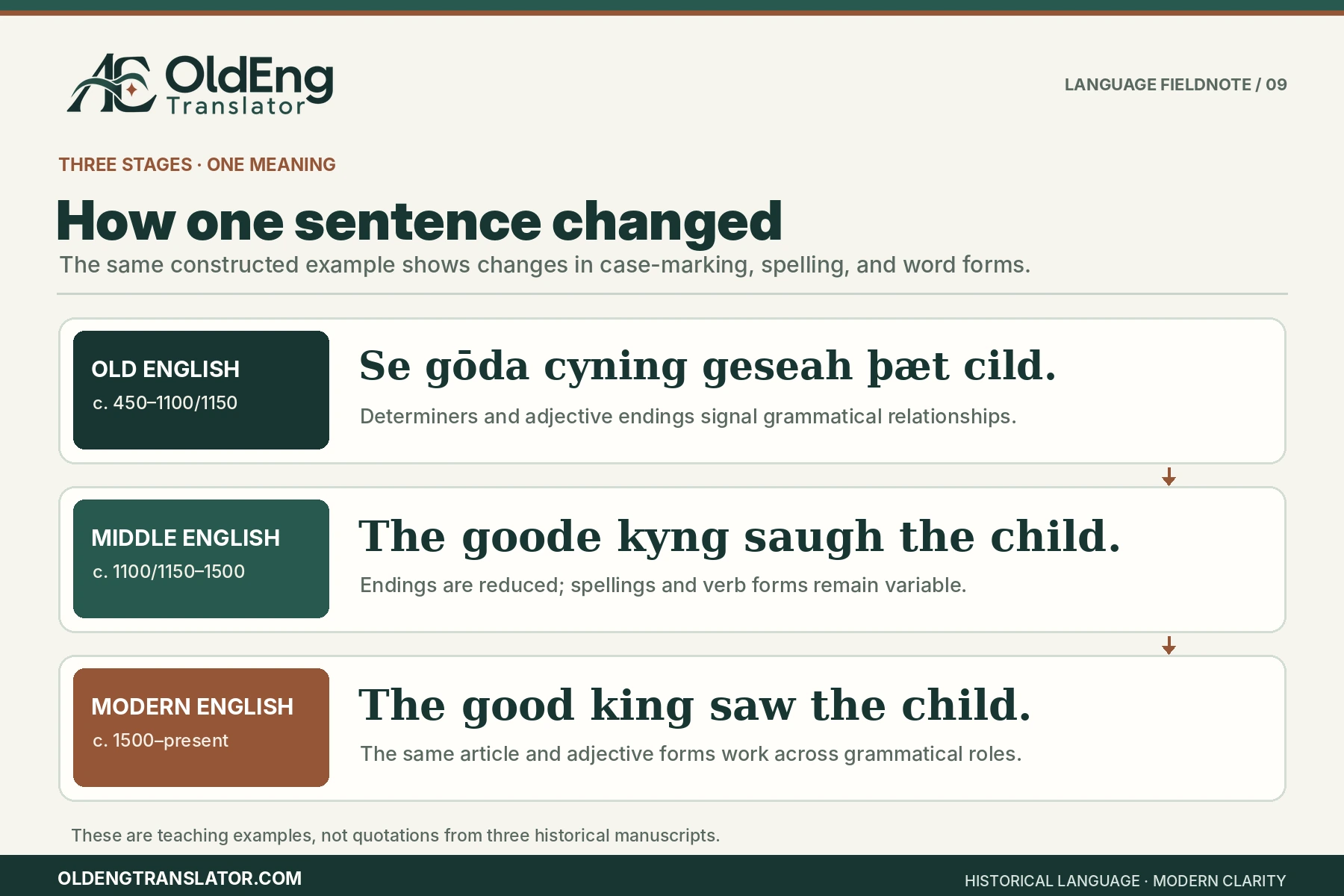
Consider the following comparison. All three sentences are constructed illustrations, not quotations taken from successive manuscripts. Their forms are chosen to make a broadly West Saxon Old English pattern, a plausible late Middle English pattern, and an ordinary present-day English sentence easy to compare.
| Language stage | Sentence | Modern meaning |
|---|---|---|
| Old English | Se gÅda cyning geseah þæt cild. | The good king saw the child. |
| Middle English | The goode kyng saugh the child. | The good king saw the child. |
| Modern English | The good king saw the child. | The good king saw the child. |
The most revealing differences are grammatical, not decorative.
The word for “the.†Old English se is a masculine singular nominative form, used here with the subject cyning; þæt is neuter singular accusative with cild, the object. The later the no longer identifies those case-and-gender distinctions. Modern English uses the same the for both phrases.
The word for “good.†Old English gÅda has an ending associated with the adjective’s weak form after the determiner. Late Middle English goode still shows a surviving adjective ending in the illustrated construction. Modern good has no corresponding agreement ending.
The verb “saw.†Old English geseah, Middle English saugh, and Modern English saw reflect a history of sound and form changes. The Middle English spelling saugh is a documented past-tense form; it is not simply a made-up archaic respelling of saw.
There are limits to what this table proves. Old English was not uniformly West Saxon, Middle English was not one standard dialect, and different manuscripts can spell the same word differently. The example shows a defensible structural contrast, not the only possible historical wording.
What Actual Middle English Looks Like: Reading Chaucer
The constructed comparison is useful precisely because it holds the meaning constant. A real literary text brings additional complications: poetic meter, regional spelling, and vocabulary chosen for a particular setting.
Geoffrey Chaucer begins the General Prologue to The Canterbury Tales with these two lines:
Whan that Aprill with his shoures soote The droghte of March hath perced to the roote
The text is reproduced with a Modern English gloss by Harvard University’s Geoffrey Chaucer Website. A close rendering of the excerpt is: “When April, with its sweet showers, has pierced March’s drought to the root …â€
The final dots matter. These two verses do not form a complete sentence: the opening Whan introduces a long subordinate construction, and the principal thought comes later, when people begin longing to go on pilgrimages. Translating the first two lines as if they were a finished statement would misrepresent Chaucer’s syntax.
Several forms reward attention:
| Chaucer’s wording | Modern interpretation | What has changed or survived? |
|---|---|---|
| Whan | when | Recognizable question/conjunction word with different spelling. |
| Aprill | April | Similar word, variable medieval spelling. |
| his shoures | its showers | His can refer to a nonhuman noun; present-day standard English ordinarily uses its. |
| soote | sweet | A historical adjective whose form and vowel differ from present-day usage. |
| hath perced | has pierced | Older third-person verb ending and spelling, but a recognizable perfect construction. |
| roote | root | A final written -e that cannot simply be assigned a modern pronunciation. |
A present-day reader can make progress through Chaucer before consulting a dictionary, yet understanding every line still requires linguistic and literary interpretation. The passage also shows why Middle English is not just Modern English with a few unusual letters.
The Biggest Grammatical Change: From Endings to Word Order
The reduction of inflectional endings is one of the most important differences between Old and Middle English. Old English nouns, adjectives, and determiners distinguished grammatical cases; their forms often signaled a subject, an object, possession, or an indirect relationship.
In se gÅda cyning … þæt cild, the subject and object phrases have different grammatical marking. A modern sentence such as “The child saw the king†instead depends much more directly on which noun phrase comes before and after the verb. Changing their positions normally changes who did what.
Old English word order was never random, and Middle English did not immediately lose every case ending. The change happened unevenly. But as unstressed endings weakened and merged, word order and prepositions carried more of the work that inflection had previously done.
Pronouns preserve some older distinctions even today. Compare he, him, and his: these forms still signal different functions. Ordinary nouns retain much less of that case system, while most adjectives no longer change for grammatical gender, number, or case.
Verb endings changed too. Chaucer can write hath where present-day English normally has has, and Middle English texts may contain third-person forms ending in -eth alongside regional forms ending in -s. Plural forms in -en likewise survived in some Middle English systems. Modern standard English retains such contrasts as I see versus she sees, but the older range was broader.
The detailed declensions and conjugations belong to the Old English Grammar guide. In this comparison, the key point is that English did not lose grammar: the language changed the ways in which grammatical relationships are expressed.
Vocabulary: Germanic Foundations, Norse Contact, and French Borrowing
The oldest layers of everyday English remain readily visible. Words connected with family, household life, basic actions, and natural objects often descend from Old English. Yet a Modern English sentence may place inherited vocabulary beside words introduced through later contact.
| Inherited or older English word | Related later borrowing | Why both can coexist |
|---|---|---|
| king | royal (French-derived) | The two words often describe related ideas but serve different grammatical and stylistic roles. |
| ask | question (French-derived) | A native verb and a borrowing associated with inquiry can coexist without becoming identical synonyms. |
| cow | beef (French-derived) | Modern English usually distinguishes the animal and its meat. |
| sheep | mutton (French-derived) | Another familiar contrast between livestock and meat vocabulary. |
These pairs are illustrations of vocabulary layering, not a claim that every borrowed word entered on one date or that native speakers and French speakers always used separate names for animals and meals. Meanings often continued to shift after borrowing.
Scandinavian contact belongs to this history as well. Forms associated with Old Norse helped shape words such as sky and get, while the rise of they, their, and them is traditionally connected with Norse-influenced pronoun forms. Specialists continue to examine how those pronouns spread and how to interpret the earliest evidence, so describing their history as a single instantaneous replacement would oversimplify it.
The Norman Conquest intensified French influence in institutions such as law, government, and elite society. In later centuries, Latin and Greek contributed heavily to scholarly, scientific, and technical vocabulary. English kept its Germanic core while acquiring additional ways to express closely related concepts.
It is also worth separating a borrowed word’s origin from its meaning in a specific sentence. An inherited word can shift sense just as a borrowed word can. The Old English Words and Meanings reference addresses those historical meaning changes without assuming that modern lookalikes are safe translations.
Why the Spelling Looks Different—and Why Modern Words Sound Different
Three different processes are easy to confuse: replacing a writing convention, changing the pronunciation of an existing word, and choosing a different word altogether.
| Earlier written form | Middle English example | Modern form | What this demonstrates |
|---|---|---|---|
| hūs | hous | house | Related word, with later changes in vowel sound and spelling. |
| cniht | knyght | knight | Consonants once pronounced were later lost, while spelling retained traces. |
| scip | ship | ship | A change in conventional spelling for a related word. |
| cwēn | quene | queen | Changes in letter combinations and later spelling conventions. |
These are representative spellings, not a single unbroken chain copied from three manuscripts. Middle English spelling varied widely by writer and region. An editor may also add macrons to Old English forms, so hūs is not necessarily how the word looked on a particular manuscript page.
The pronunciation story is equally important. During the later Middle English and Early Modern English periods, a series of linked changes commonly called the Great Vowel Shift altered the pronunciations of long vowels. For example, the long vowel in older hūs ultimately developed toward the vowel heard in present-day house. Spelling conventions did not consistently change to keep pace.
The Great Vowel Shift was not the only sound change in the history of English. Changes to consonants, unstressed vowels, and syllable structure began earlier and continued in different regional forms. Nor did printing instantly freeze all spelling. Printing and later standardization encouraged greater consistency while pronunciation kept evolving.
This explains the seeming paradox: Middle English may be easier to recognize on the page than Old English, but reading it aloud with present-day sound values can still be seriously misleading. For the earlier language’s reconstructed sounds, see Old English Pronunciation. For the special characters and manuscript conventions that editors normalize, consult Old English Alphabet.
Did the Norman Conquest Create Middle English?
No. The conquest was a major political and sociolinguistic turning point, not the instant birth of a new spoken language.
After 1066, French became prominent in the royal court and other elite settings, while Latin retained important religious and scholarly functions. English continued to be spoken across society and was still written, though the amount and character of surviving English writing changed. Contact with French encouraged borrowing and affected writing practices over time.
Meanwhile, some of the changes associated with Middle English were already in motion: variation in unstressed endings, changes in word forms, and interaction among English and Scandinavian-speaking communities. The outcomes were shaped by generations of speakers, not issued by royal decree.
A useful distinction is between external history—who governed, what languages had prestige, which texts survived—and internal linguistic change—what happened to sounds, endings, syntax, and vocabulary. Both help explain the movement from Old to Middle English. Neither explains it adequately by itself.
Could an Old English Speaker Understand Chaucer—or Shakespeare?
There is no direct experiment that can tell us exactly how much an eleventh-century speaker would have understood of a fourteenth-century poem. Their vocabulary, pronunciation, grammar, and familiar cultural references differed, and comprehension would depend on the people, dialects, and circumstances involved.
What can be said is that the distance between Old English and Chaucer’s Middle English was substantial, while the language of Shakespeare belongs to the Early Modern English period and is structurally much closer to present-day English. Shakespeare’s thou and hath are not evidence that he wrote in Anglo-Saxon, and Chaucer’s recognizable Whan and Aprill do not turn his poetry into Modern English.
A present-day reader also has advantages that historical speakers would not have: edited texts, glossaries, translations, and centuries of hindsight. Ease of reading is therefore not a simple measure of how mutually intelligible two spoken varieties would have been.
How to Tell Which Stage of English You Are Reading
A single word is rarely enough to date a passage. A better approach is to check several features together:
- Word endings and determiners: An Old English passage may show forms such as þone and -um that express case relationships no longer regularly marked on ordinary Modern English nouns.
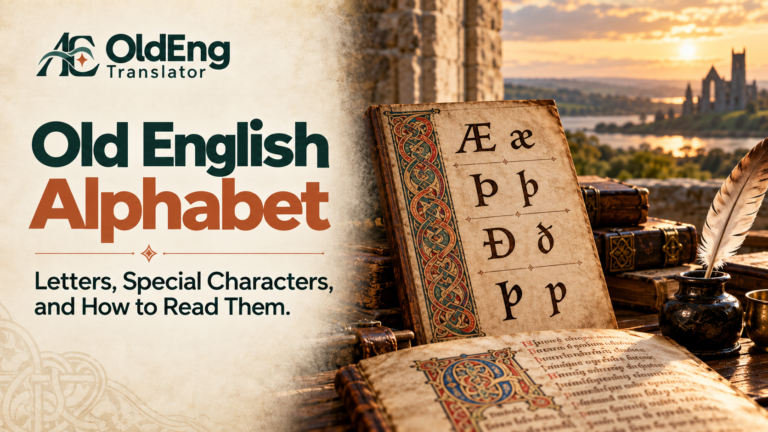
- Spelling conventions: Thorn, eth, ash, and wynn can suggest Old English, but their presence alone cannot establish the date; thorn, for example, survived into some Middle English writing.
- Verbs and pronouns: Forms such as hath, -eth, -en, thou, and ye can help identify an older system, yet many persisted across more than one period or dialect.
- Vocabulary and textual setting: Borrowed terms, personal names, genre, and the historical source can provide clues, but none operates as a universal dating formula.
Then check what kind of text you have. A manuscript might be a late copy of an earlier work; a modern edition might normalize historical spelling; a writer might deliberately imitate older language. The date of the surviving document and the linguistic stage reflected in its contents need not be identical.
If you’re unsure whether a passage is genuinely Old English, identify its source before attempting a translation. The How to Read and Translate Old English guide gives a method for working from original wording to a defensible interpretation. The Old English Translator can help explore Old English words and phrases, but a text from Chaucer or Shakespeare should not be assumed to be Anglo-Saxon simply because it looks old.
The three labels are useful because the changes are real. They are also limited: English has always varied by place, writer, speaker, and time. The clearest comparison comes from examining the grammar, vocabulary, sounds, and written evidence together rather than searching for the single year when one kind of English became another.
Written by Arthur Westmer Editorial review: OldEngTranslator.com Editorial Team