Old English guide
Old English Runes: The Anglo-Saxon Futhorc, Its Letters, and Surviving Inscriptions
The blade of a tenth-century Anglo-Saxon seax carries something unusual: a row of 28 runes , followed by the name Beagnoth . Its characters are not a secret language. They are evidence for a writing system that could represent words in Old English, even as most lengthy surviving Old English texts were being written in Latin-derived letters.
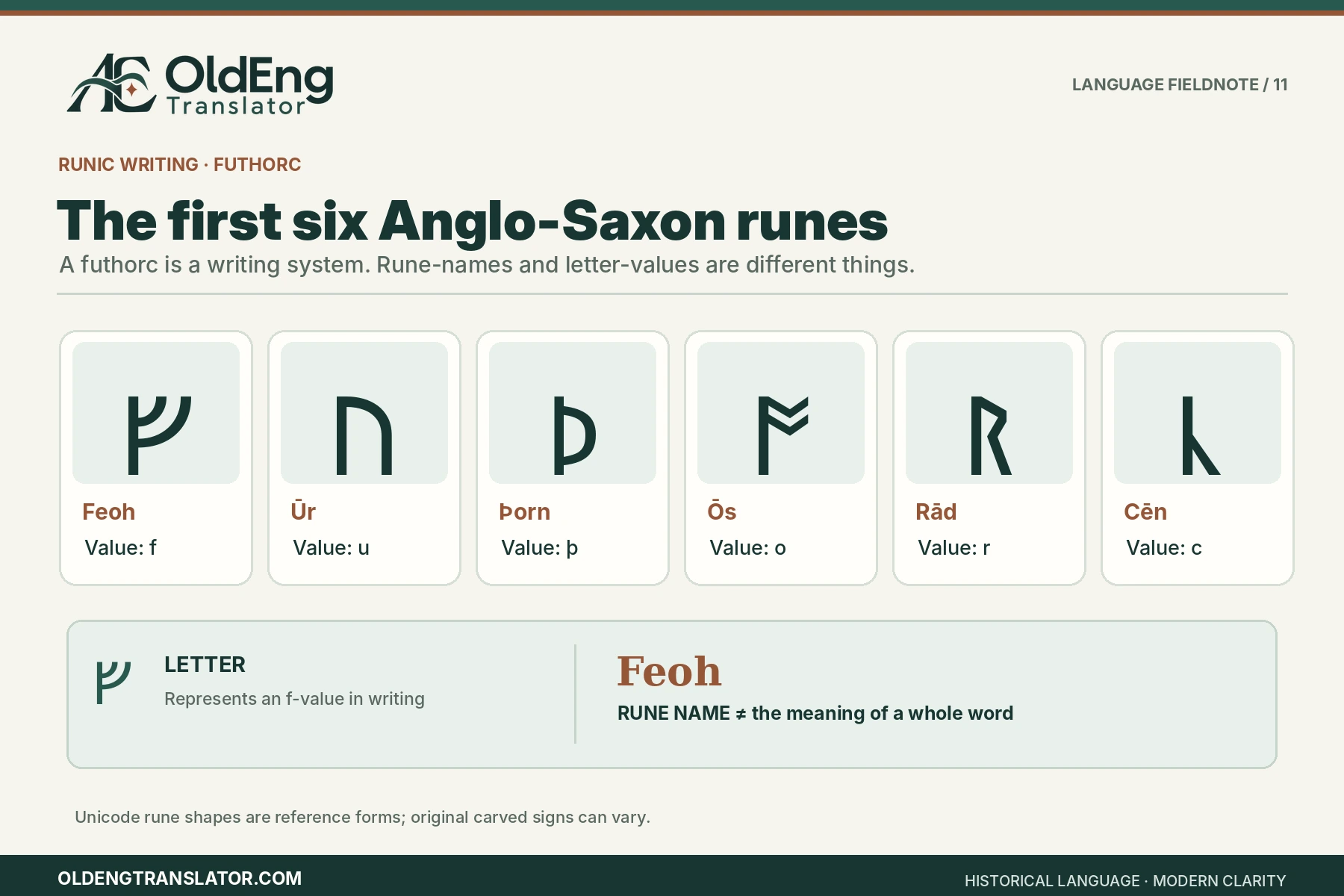
That writing system is usually called the Anglo-Saxon futhorc. Its name comes from the sounds represented by its opening six runes: f, u, þ, o, r, c. But there was no single, unchanging runic alphabet used across all of early medieval England. The number and shapes of runes varied; some are recorded in inscriptions, while others are chiefly known from later manuscript lists.
The best way to understand Old English runes is to begin with the characters themselves, then examine the objects on which people actually used them. That also reveals the limits of simply converting modern English letters into runic symbols.
What Is the Anglo-Saxon Futhorc?
Futhorc is the conventional name for the runic writing system used in early medieval England and, in related forms, in Frisia. It developed from older Germanic runic traditions and adapted as the sounds of the languages changed. Scholars also use the term Anglo-Frisian runes when discussing the related evidence from Britain and the continental North Sea coast.
The first six signs in a common normalized display are:
ᚠᚢ ᚦ ᚩ ᚱ ᚳ
They are conventionally transliterated f – u – þ – o – r – c. The character þ represents the th consonant familiar from words such as thin and this. The final c is a historical letter value, not a claim that every Old English c always had precisely the same pronunciation.
Runes were written on objects including metalwork, jewellery, bone, and stone. Their angular shapes often suit cutting and carving, although surviving examples also include signs made by other techniques, such as metal inlay. The futhorc was used over centuries in which Latin-alphabet writing also flourished. It was never the only way to record Old English.
Futhorc, Elder Futhark, and Younger Futhark
Three names commonly appear together on rune charts, but they refer to different historical systems.
| System | Typical rune inventory | Historical relationship |
|---|---|---|
| Elder Futhark | 24 | Earlier Germanic rune-row used across parts of northern Europe. Its opening sequence is usually represented f-u-þ-a-r-k. |
| Anglo-Saxon futhorc | Expanded inventory; counts vary | Developed from older runes in England and Frisia, with signs suited to additional vowel distinctions. Its opening sequence is f-u-þ-o-r-c. |
| Younger Futhark | 16 | Later Scandinavian system, associated especially with the Viking Age; it reduced the number of rune signs rather than expanding them in the same way. |
A symbol chart labelled “Viking runes†therefore cannot be assumed to represent the writing used on an Anglo-Saxon object. Some rune shapes are shared across systems, but the inventories, conventions, and sound values are not identical.
Anglo-Saxon Rune Chart: Characters, Names, and Reading Values
The following chart supplies 29 runes associated with the Old English Rune Poem, in a commonly presented order. It is a practical reference, not a claim that all 29 appear in every historical inscription, nor that their forms and names were wholly uniform. Rune shapes are displayed as modern Unicode characters; the appearance of a carved sign may differ.
| Rune | Conventional name | Approximate reading or scholarly note |
|---|---|---|
| áš | Feoh | f; the name refers to property or wealth, historically including livestock. |
| ᚢ | Ūr | u; traditionally associated with the aurochs. |
| ᚦ | Þorn | þ, the th consonant; name means thorn. |
| áš© | ÅŒs | o; the name and its interpretation have a complex history. |
| áš± | RÄd | r; associated with riding or a journey. |
| áš³ | CÄ“n | c; historically used for values related to Old English c. |
| áš· | Gyfu | g; name means gift. |
| áš¹ | Wynn | w; name means joy. |
| ᚻ | Hægl | h; name means hail. |
| ᚾ | Nȳd | n; name refers to need or constraint. |
| ᛠ| Īs | i; name means ice. |
| ᛄ | Gēr | Conventionally j, historically a y-like consonantal value in relevant forms; name means year. |
| ᛇ | Ēoh | Historical sound value is uncertain; associated with the yew tree. |
| ᛈ | Peorð | p; the meaning of its name is disputed. |
| ᛉ | Eolh-secg | Often transliterated x in an Anglo-Saxon context; its interpretation requires caution. |
| ᛋ | Sigel | s; name refers to the sun. |
| á› | TÄ«r | t; conventional identification and interpretation of the name are discussed by scholars. |
| á›’ | Beorc | b; name means birch. |
| á›– | Eh | e; name means horse. |
| á›— | Mann | m; name refers to a person. |
| ᛚ | Lagu | l; name refers to water or sea. |
| á› | Ing | A value conventionally represented ng; linked with the name Ing. |
| ᛟ | Ēþel | A vowel value conventionally transliterated œ in some systems; name refers to inherited homeland or estate. |
| ᛞ | Dæg | d; name means day. |
| ᚪ | Āc | a; name means oak. |
| ᚫ | Æsc | æ; name means ash tree. |
| ᚣ | Ȳr | y, the Old English vowel value; interpretation of the name is debated. |
| ᛡ | Īor | Associated with io in some charts; exact historical use is uncertain. |
| á› | Ä’ar | ea; its rune-poem stanza concerns death and the grave. |
Why are some values qualified? Modern transliteration is a scholarly way of labelling rune signs, not a flawless phonetic recording. Certain runes are rare, their names survive through complicated manuscript transmission, and their sound values or uses changed. In particular, ᛇ, ᛉ, and ᛡ should not be presented as having one unquestionably established sound in every period.
The names are informative too, but they are not automatic translations of every occurrence of the characters. When áš appears as a letter in a word, it generally contributes an f-value; it does not necessarily add the concept “wealth†to the sentence. Confusing a rune’s name with its role in spelling is one of the main errors in popular rune charts.
Why Do Sources Give 28, 29, 31, or More Runes?
A rune count needs a named source. Twenty-eight signs appear in the runic row on the Seax of Beagnoth. Twenty-nine runes receive stanzas in the surviving text of the Old English Rune Poem. Some scholarly and museum descriptions discuss an Anglo-Saxon inventory of 31, while manuscript rune-rows and rarer forms can lead to still higher counts.
Those numbers describe different kinds of evidence, not necessarily competing attempts to count an identical fixed alphabet. A rune may belong to a manuscript list without having secure examples carved in inscriptions; a local or late sign may not occur in an earlier row; another character may be a variant rather than a clearly separate letter.
For this reason, a 29-character reference chart is useful for learning the Rune Poem, but not a universal key for dating or reading every Anglo-Saxon inscription. The actual object and its archaeological and linguistic context remain decisive.
The Seax of Beagnoth: A Rune-Row Preserved on a Blade
The Seax of Beagnoth is a long, single-edged iron blade found in the River Thames at Battersea and now held by the British Museum. The museum dates it to the tenth century. It carries inlaid decoration and two inscriptions in runes: a row of 28 runic characters and the name Beagnoth, plausibly that of an owner or maker, though that person’s identity cannot be established securely.
The object’s significance is greater than the name alone. It preserves an extended sequence of runic signs on a dated type of artefact, giving scholars material evidence to compare with rune-rows found in manuscripts. But the sequence is not perfectly regular. The museum’s catalogue discusses anomalies in its arrangement and the possibility that the maker copied a manuscript sequence imperfectly.
The British Museum’s catalogue of the Seax of Beagnoth records the object, its inscription, dating, materials, and earlier scholarly interpretations. It is a better basis for understanding this artefact than a modern graphic presenting its characters as a timeless magical alphabet.
Reading the First Six Runes
A normalized Unicode illustration of the futhorc’s opening sequence is:
ᚠᚢ ᚦ ᚩ ᚱ ᚳ → f u þ o r c
This demonstration shows transliteration: representing rune signs with familiar scholarly letters. It is not a translation into Modern English, because a letter sequence does not by itself communicate a sentence. The exact rune shapes and spacing on the blade should be checked against an image or specialist transcription of the object; Unicode characters do not reproduce every detail of the metal inlay.
The other inscription, Beagnoth, shows that runes could write a personal name. The full runic row beside it should not be mistaken for a sentence whose “hidden meaning†is supplied by adding together each rune-name’s dictionary gloss.
What the Franks Casket and Ruthwell Cross Tell Us
The Seax of Beagnoth is not the only important witness. Other objects show runes used for very different purposes, sometimes alongside Latin letters and explicitly Christian imagery.
The Franks Casket, an elaborately carved whalebone box dated to the early eighth century, carries inscriptions in Old English and Latin. Its panels depict a striking combination of Germanic legend, Roman history, and Christian subjects. The front includes a runic alliterative text about the whale whose bone became the box. Some other sections employ unusual or encoded rune forms, making the inscriptions more complicated than a straightforward alphabet substitution.
The casket is evidence for an accomplished literary and visual use of runes. Its writing belongs to a particular artefact and cultural setting; interpreting it requires the words, carved images, direction of reading, and conventions of the text to be considered together. The British Museum’s description also identifies linguistic features associated with a Northumbrian or northern Mercian background.
The Ruthwell Cross, created in the early eighth century in what was then a zone of Northumbrian influence and is now southwestern Scotland, offers a different picture. It is a Christian stone monument with biblical sculpture, Latin inscriptions, and runic verse related to The Dream of the Rood. The runic text speaks from the cross’s perspective about the Crucifixion.
The exact relationship between the inscription and later manuscript versions of the poem is a subject of textual scholarship; the surviving readings should not simply be assumed identical. Still, the cross establishes something unmistakable: Anglo-Saxon runes could carry Christian poetry. The existence of a runic inscription does not, on its own, identify an object as pre-Christian or a text as a pagan ritual.
The three objects also demonstrate that the futhorc was not one narrow kind of writing. It could be used for a sequence of characters, a personal name, an intricate poetic inscription, or a monumental religious text.
The Old English Rune Poem and What Its Names Mean
The Old English Rune Poem is a sequence of 29 short stanzas, each associated with a rune. The verses describe subjects connected with the rune-names: wealth, weather, plants, human life, and other concepts. It is one of the principal sources for the traditional names of Anglo-Saxon runes.
The way it survives is unusually important. Its sole known manuscript witness was in Cotton MS Otho B X, and the leaf containing the poem was lost in the fire that damaged the Cotton collection in 1731. Fortunately, the text had been printed by George Hickes in 1705. Modern editions consequently depend on that early printed witness rather than a surviving manuscript page that can be independently re-examined. The British Library’s manuscript catalogue documents this transmission history.
The poem helps explain why a rune called feoh could prompt verses about property, or why hægl is associated with hail. But a stanza about the meaning of a rune-name is not proof that every instance of that character on an object was meant as an independent symbolic message.
A particularly useful distinction is between a rune used as a letter, a rune identified by its name, and a rune discussed in a poem. These are related, but they are not interchangeable uses. Historical interpretation starts by deciding which one the evidence supports.
How to Read and Transcribe an Anglo-Saxon Runic Inscription
The first task is to preserve what is physically visible. A photograph or drawing may show a rune’s angle, damage, orientation, or relationship to neighbouring marks in a way that a modern typed line cannot.
A careful reading proceeds through several separate stages:
- Identify the object and writing system. Establish its find context, likely period, and whether the forms are Anglo-Saxon futhorc, a different runic tradition, or a mixture of scripts.
- Record the visible signs. Note damaged or incomplete runes and any possible dividers. Do not silently supply missing characters.
- Transliterate the signs. Represent each sign with a conventional Latin-script value, distinguishing uncertain values from secure ones.
- Consider word boundaries and spelling. Inscriptions may have unconventional spacing, variant spellings, unusual directions, or forms whose reading depends on the object’s layout.
- Identify the Old English words and grammar. A Latin-letter transliteration still needs vocabulary, inflection, and contextual interpretation before it becomes an English translation.
- Compare scholarly readings. Where a text is damaged or disputed, check specialist interpretations rather than claiming that one typed conversion is definitive.
For instance, the name Beagnoth on the seax can be understood as a personal name without pretending that the accompanying rune-row is an ordinary sentence. On the Ruthwell Cross, the runes represent a literary passage that must be interpreted through Old English vocabulary and verse as well as the physical inscription.
The word-analysis stages are closely related to those described in How to Read and Translate Old English. Reading an inscription adds an earlier stage: before interpreting the language, you must establish which signs are actually present.
Can You Write Modern English in Anglo-Saxon Runes?
You can create a modern transliteration that represents some letters or sounds using runic characters. But the result should be labelled as a modern rendering, not automatically as an authentic Anglo-Saxon inscription.
There are several reasons:
- Modern English sounds have changed. A present-day word may need different spelling decisions from its Old English ancestor.
- The alphabets do not match one-to-one. Old English runes were adapted to an earlier sound system; a modern keyboard’s A–Z keys do not correspond neatly to a historical futhorc.
- Rune-rows varied. Choosing one online 29-rune chart does not demonstrate that every selected symbol would have been used together in a particular century or region.
- Language and script are separate. Writing a modern English sentence in runic characters changes its appearance. It does not turn its words or grammar into Old English.
The last point is fundamental. If the intention is to express a thought in the historical language, the wording itself must first be evaluated as Old English. Our Old English Grammar guide explains some of the inflectional forms involved. A runic rendering adds a separate question about whether the signs suit the intended dialect, period, and source tradition.
Modern Unicode runes are useful for display and copying, but software fonts may show different shapes, and some devices lack full runic font support. Digital characters are a representation of a historical script, not a facsimile of a particular carved inscription.
How Runes Relate to the Latin Old English Alphabet
Most substantial surviving Old English prose and poetry was transmitted in Latin-based writing. That script included þ (thorn) and ƿ (wynn), two characters with runic ancestry that scribes adapted into written Old English. The existence of these letters does not make a page written in the Latin alphabet a runic inscription.
Conversely, using runes to write an Old English word does not create a different language. A runic and a Latin-script form can represent the same underlying word, although their spelling conventions and what survives of the evidence may differ.
This is the boundary between two separate reference topics. The Old English Alphabet guide explains the letters most readers encounter in manuscripts, including thorn, eth, ash, wynn, and editorial conventions. The futhorc is the distinct historical writing system visible on objects such as the Seax of Beagnoth and Ruthwell Cross.
The Old English Dialects guide provides another relevant caution: an inscription’s geographical findspot, the form of the language it records, and the origin of the person who made it do not necessarily coincide. That is why a single sign or location cannot establish a complete regional reading.
If you are exploring what an Old English word or passage means, begin with its linguistic form and use the Old English Translator for an initial reading. If it is carved in runes, establish the inscription’s text before interpreting that result. A historically responsible runic reading keeps the artefact, its signs, its language, and its meaning distinct.
Written by Arthur Westmer Editorial review: OldEngTranslator.com Editorial Team