Old English guide
Old English Words and Meanings: A Practical Vocabulary Reference
The Old English adjective sæd looks almost identical to modern sad , but it meant sated, filled, or having had enough . Likewise, cwic meant alive , not simply quick in the modern sense of fast. These are useful reminders that recognizing an old word is different from understanding it.
The vocabulary below brings together common Old English words for people, places, nature, actions, and everyday description. It uses broadly normalized spellings, including macrons that modern editors often add to show long vowels. Meanings are deliberately given as working glosses, not promises that one modern English word will fit every historical sentence. The same Old English word may have several senses, and the right one depends on context.
How to Use the Word Lists
Most entries appear in their dictionary form. For nouns, that is ordinarily the nominative singular; verbs are given as infinitives, such as cuman (“to comeâ€), rather than as the particular tense used in a passage. Adjectives are usually listed in a basic form, which may change when placed beside a noun.
The spellings follow common editorial conventions, largely those familiar from West Saxon teaching texts. A manuscript may have a regional variant, an unfamiliar letterform, or no mark above a long vowel. The Old English Alphabet guide explains how manuscript letters and modern editorial spelling differ. Pronunciation is a separate question: hūs and its descendant house are related, but they should not be pronounced alike simply because the meanings match.
A compact list is most useful for recognizing a likely meaning and finding the next question to ask. It cannot stand in for a historical dictionary entry with examples of usage.
People, Family, and Relationships
Old English distinguished family relationships, age, social position, and personal ties through words that do not always divide the world the same way Modern English does.
| Old English | Useful English meaning | Important distinction |
|---|---|---|
| mann | person, human being; man | Can refer to a human being of either sex. |
| wer | man, male person | More specifically male than the broad sense of mann. |
| wīf | woman, wife | Not limited to a married woman. |
| cild | child | An ordinary word for a child. |
| bearn | child, offspring | Often emphasizes descent or a parent–child relationship. |
| fæder | father | A recognizable family term. |
| mÅdor | mother | Related to modern mother. |
| sunu | son | A direct ancestor of modern son. |
| dohtor | daughter | The consonants reflect an older pronunciation. |
| brÅþor | brother | Thorn writes the th sound. |
| sweostor | sister | Also appears in variant manuscript spellings. |
| frÄ“ond | friend | Can also appear in forms such as frÄ“ondas (“friendsâ€). |
| fēond | enemy, foe | Similar in appearance to frēond, but opposite in sense. |
The distinction between mann and wer is particularly important. Translating every occurrence of mann as an exclusively male man can misrepresent a passage about people in general. Similarly, bearn and cild overlap, but a reference to someone’s offspring may invite bearn where the modern translation simply says child.
Words also reflected historical social arrangements. Ceorl could describe a free commoner or rural man in particular contexts; eorl denoted a person of elevated standing or rank. Neither should be equated automatically with a modern occupation or title. Such meanings have to be read in the society and document in which they occur.
Home, Food, and Familiar Objects
A familiar modern translation can conceal differences in the way a place or object was understood.
| Old English | Useful English meaning | Reading note |
|---|---|---|
| hūs | house, building | Emphasizes a building or dwelling. |
| hÄm | home, dwelling, settlement | Can refer to a home or inhabited locality. |
| tūn | enclosure, homestead, estate, settlement | An ancestor of modern town, but not necessarily a modern urban town. |
| duru | door | A common everyday noun. |
| bÅc | book | Its plural can appear as bÄ“c. |
| word | word, utterance | May appear with wynn (Æ¿) in manuscript writing. |
| hlÄf | loaf, bread | Not restricted to the modern sense of one packaged loaf. |
| wæter | water | A recognizable native word. |
| meolc | milk | Also occurs with variant spellings. |
| fisc | fish | Its sc spelling has a historical sound value. |
| scip | ship | Often a vessel, not necessarily any modern kind of boat. |
| weorc | work, task, deed | Its meaning is broader than paid employment. |
HÅ«s, hÄm, and tÅ«n are not three interchangeable spellings for house. A building, the place one calls home, and an enclosed settlement may overlap in experience without being the same thing. The difference is useful in boundary descriptions and accounts of settlements, where translating tÅ«n as a modern town may create the wrong picture.
Similarly, Old English vocabulary reflects the objects and practices of its time. A word’s modern descendant does not establish that the object, institution, or social setting was identical to the present-day one.
The Natural World and the Passing of Time
Many Old English nature words have familiar descendants, but their spellings preserve older vowels and consonants. The table is organized by what a reader is likely to encounter in a description rather than by modern alphabetical order.
| Old English | English meaning | Old English | English meaning |
|---|---|---|---|
| eorþe | earth, ground | heofon | heaven, sky |
| sǣ | sea | land | land, country, territory |
| wudu | wood, forest | trēow | tree |
| wind | wind | snÄw | snow |
| regn | rain | sunne | sun |
| mÅna | moon | dæg | day |
| niht | night | Ä¡Ä“ar | year |
| sumor | summer | winter | winter |
The modern-looking Ä¡ in Ä¡Ä“ar is an editorial pronunciation aid, not a character that every Anglo-Saxon scribe wrote. Likewise, a macron above sÇ£ or mÅna indicates reconstructed vowel length in a modern edition, rather than a uniformly marked feature of original manuscripts.
The words are especially useful when reading landscape descriptions, calendars, and accounts of travel. But land may be territory rather than a stretch of soil, and heofon may evoke the visible sky or heaven in a religious setting. Even apparently simple vocabulary requires the surrounding passage.
Common Old English Verbs
English speakers often recognize a verb’s meaning before recognizing the form that appears in a manuscript. These entries give infinitives, the forms normally used for dictionary lookup.
| Old English infinitive | Core meaning | Related form or caution |
|---|---|---|
| cuman | to come | Past singular cÅm (“cameâ€). |
| gÄn | to go | An irregular verb; do not assume all forms resemble gÄn. |
| sittan | to sit | Appears with changed vowels in its past forms. |
| standan | to stand | A common strong verb. |
| sprecan | to speak | Also appears with variant spellings. |
| secgan | to say, tell | Often introduces reported speech. |
| sēon | to see | Forms can differ considerably from the infinitive. |
| etan | to eat | The past tense has a different stem vowel. |
| drincan | to drink | Past singular dranc (“drankâ€). |
| beran | to carry, bear, produce | The right gloss depends on what is being borne. |
| findan | to find | Both literal and extended senses are possible. |
| habban | to have, possess | Frequently appears in less obvious inflected forms. |
| lufian | to love | A weak verb; compare noun lufu (“loveâ€). |
A translation from Modern English should not take the dictionary infinitive and simply place it where a finite verb belongs. Cuman is “to comeâ€; cÅm is a past form meaning “came.†A sentence needs its own grammatical construction.
The same caution applies in reverse. Someone looking for dranc in an alphabetical list of infinitives may miss it until they identify the base verb drincan. The Old English Grammar guide explains how such strong-verb changes and noun endings help establish sentence meaning.
Describing Things and Connecting Ideas
A short Old English passage depends heavily on adjectives, negatives, conjunctions, and question words. These can matter more to the sense of a sentence than a long list of isolated nouns.
| Old English | Useful English meaning | Note |
|---|---|---|
| eald | old | May take other endings beside nouns. |
| geong | young | Not pronounced like modern geong would be if read letter by letter. |
| nīwe | new | Also written with spelling variants. |
| micel | great, large, much | Size, quantity, or degree depends on context. |
| lȳtel | little, small | Can describe size or amount. |
| lēof | dear, beloved, pleasing | Often expresses affection or esteem. |
| sÅþ | true | Related to ideas of truth and correctness. |
| eall | all, every, entire | Inflected forms appear in sentences. |
| sÅna | immediately, straightaway | Often stronger than modern soon. |
| ne | not | Commonly placed with a verb in negation. |
| ac | but, however | Marks a contrast. |
| hwÄ | who | Asks ‘who?’ and also occurs in indefinite constructions. |
| hwæt | what | Also used in exclamatory or introductory contexts. |
| hū | how | Useful in questions and comparisons. |
The difference between lēof and lufu shows why part of speech matters: one is typically an adjective meaning dear or beloved, while the other is a noun meaning love. You cannot substitute one for the other merely because they occupy the same general area of meaning.
Old English Words That Mislead Modern Readers
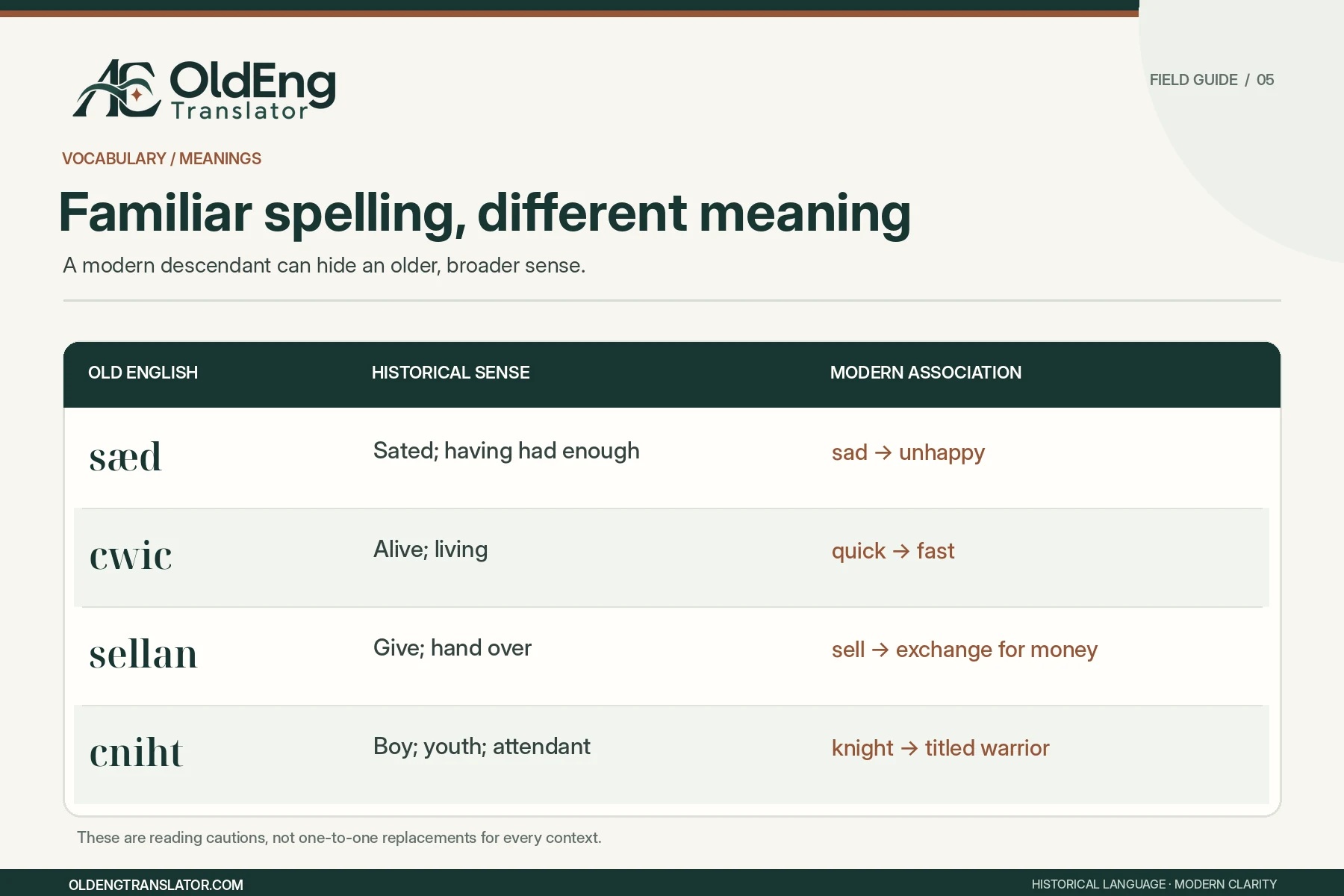
The most interesting vocabulary mistakes are often caused by familiarity, not unfamiliar letters. A historical word may survive in modern English while its meaning narrows, broadens, or shifts.
| Old English | Historical sense | Misleading modern association |
|---|---|---|
| sæd | sated, full, weary from having enough | Not modern sad in the sense of unhappy. |
| cwic | alive, living | Modern quick usually means fast. |
| sÅna | immediately, straightaway | Modern soon allows a less immediate interval. |
| cearful | sorrowful, troubled, full of care | Modern careful usually means cautious. |
| sellan | to give, hand over | Modern sell usually means transfer for payment. |
| cwēn | woman or queen | Modern queen has a narrower everyday meaning. |
| cniht | boy, youth, attendant, servant | Modern knight suggests a particular social rank. |
| steorfan | to die | Modern starve commonly means suffer or die from lack of food. |
| cræftig | skilful, ingenious | Modern crafty often implies cunning or deception. |
| stenc | smell, odour, sometimes fragrance | Modern stench implies a bad smell. |
These are not ten unrelated curiosities. They illustrate three recurring problems: meaning can narrow (cwēn), a word can take on a different emphasis (cræftig), and the modern descendant may suggest only one historical possibility (sellan).
Take sæd. A reader who translates it as sad because the letters look similar may reverse the sense of a passage. The historical adjective describes being filled or sated, and in some contexts weary from having had enough. Here a dictionary sense is not an optional refinement; it changes the interpretation.
Similarly, steorfan did not require hunger as the cause of death. Translating it mechanically as modern starve could add an explanation absent from the original. This is why a modern descendant is evidence of word history, but not necessarily an adequate translation.
One English Idea, Several Old English Words
Modern English encourages us to ask, “What is the Old English word for child?†Historical texts often require a better question: which aspect of the idea does the passage express?
Child or offspring. Cild is a common word for a child; bearn can emphasize a child as someone’s offspring or descendant. Cniht might refer to a boy or young attendant, and cannot be substituted for either word in every context. The differences matter when age, family relationship, or social role is part of the passage.
Home or settlement. HÅ«s normally directs attention to a house or building. HÄm can indicate one’s home or a dwelling locality; tÅ«n evokes an enclosure, homestead, or settlement. An English sentence containing home may point to any of these ideas depending on what is meant.
Affection and relationship. Lufu names love; lēof describes someone or something dear or beloved; frēond identifies a friend. An affectionate relationship may involve all three concepts, but the words are not grammatical or semantic substitutes.
This is not a reason to treat every gloss as endlessly uncertain. Many occurrences are quite clear. It is a reason to avoid supplying a single unqualified “Old English translation†for an abstract modern word when the intended relationship, object, or setting has not been specified.
Recognizing a Word When Its Form Changes
Vocabulary tables generally list headwords. Texts contain grammatical forms. The difference becomes visible in a few compact examples:
| Dictionary form | Form found in text | What it can mean |
|---|---|---|
| frēond — friend | frēondas | friends (nominative or accusative plural) |
| bÅc — book | bÄ“c | books (nominative or accusative plural) |
| cuman — to come | cÅm | came (past singular) |
| drincan — to drink | dranc | drank (past singular) |
The first two pairs are noun forms; the last two are verbs. None should be treated as a new, unrelated vocabulary item simply because its letters differ from the headword. Conversely, the same written form can sometimes correspond to more than one grammatical role, so context still matters.
This is the practical limit of a word list: it can identify the family to which a form belongs, but it cannot establish all the relationships within a sentence by itself.
A Short Attested Example: Reading Words Together
The historical dictionary Bosworth–Toller records the wording:
He wæs Godes freónd.
A natural translation is “He was God’s friend.†The entry for freónd cites an occurrence in the Anglo-Saxon Chronicle; readers can inspect the historical evidence in the Bosworth–Toller entry for *freónd*.
This five-word excerpt shows how a familiar word can appear in a structure that is less familiar. FrÄ“ond supplies friend; wæs supplies was; Godes supplies the possessive relationship God’s. We do not need to invent an English word for each grammatical feature or rewrite the result in archaic-sounding English to preserve its meaning.
A dictionary should help establish which sense actually occurs, not simply provide an impressive collection of possible glosses. In a difficult passage, the surrounding text and the edition’s notes may be necessary to make that decision. The history of such written evidence is discussed in What Is Old English?, including why a surviving manuscript’s date is not necessarily a text’s original composition date.
When you are exploring a word or short passage, the Old English Translator can help you form an initial interpretation. For a dependable historical reading, check the word’s dictionary senses, its form in the sentence, and the source context. If the problem concerns how a familiar-looking word sounded rather than what it meant, the Old English Pronunciation guide addresses that separate question.
A useful Old English vocabulary is more than a collection of English equivalents. It is the ability to recognize an older word, understand the range of meanings it could carry, and choose a translation that fits what the historical text actually says.
Written by Arthur Westmer Editorial review: OldEngTranslator.com Editorial Team