Old English guide
Old English Phrases and Greetings: Historical Expressions and Their Meanings
Wes þū hÄl is a historically grounded way to greet one person in Old English. Its literal sense is “be well†or “be in good health,†and a form of it appears when Beowulf addresses King Hrothgar. That is a firmer starting point than the familiar lists that offer good morning , how are you? , and goodbye in Old English spelling without showing whether those expressions were actually used.
Old English, also called Anglo-Saxon, was spoken and written across several centuries and regions of early medieval England. Its surviving literature preserves greetings, wishes for health, introductions, blessings, and farewells, but not a record of every ordinary conversation. This guide distinguishes expressions found in historical texts from new sentences built with genuine Old English vocabulary and grammar. Both can be useful; they answer different questions about the past.
Old English Greetings Supported by Historical Texts
The following examples have identifiable evidence in surviving Old English sources. The spellings are presented in a readable, broadly normalized form; manuscripts and editions may differ in capitalization, vowel marks, and the use of þ or ð.
| Old English wording | Literal or natural meaning | Historical evidence and context |
|---|---|---|
| Wæs þū, HrÅðgÄr, hÄl! | Be well, Hrothgar! / Greetings, Hrothgar! | Beowulf addresses Hrothgar in Beowulf, line 407. |
| BÄ“o þū gesund! | Be healthy! / Greetings! | Appears in an Ælfrician homily; the related singular formula is also used to explain Latin salutations in Ælfric’s grammar. |
| HÄle wese gÄ“! | Be well, all of you! | A plural greeting documented in an Old English Gospel tradition. |
| Gē sind wilcuman. | You are welcome. | Attested in Christ and Satan (line 617); it describes people as welcome, not necessarily a modern reply to “thank you.†|
| Farað nu gesunde and gesÇ£lige becumað. | Go now safely and arrive happily. | A plural leave-taking wish cited from Ælfric’s Life of Saint Maurus. |
These are not five supposedly universal conversation formulas. The first comes from a heroic poem, another from religious writing, and others from translation or narrative. Such sources establish that the wording existed; they do not tell us how frequently it was spoken in every village or social setting.
The Bosworth–Toller entry for *hÄl* preserves examples of greeting formulas and identifies their textual sources. It is especially useful for checking variants such as hÄl wes þū and plural hÄle wese gÄ“ without treating one modern phrase chart as the authority.
How Did Someone Say Hello in Old English?
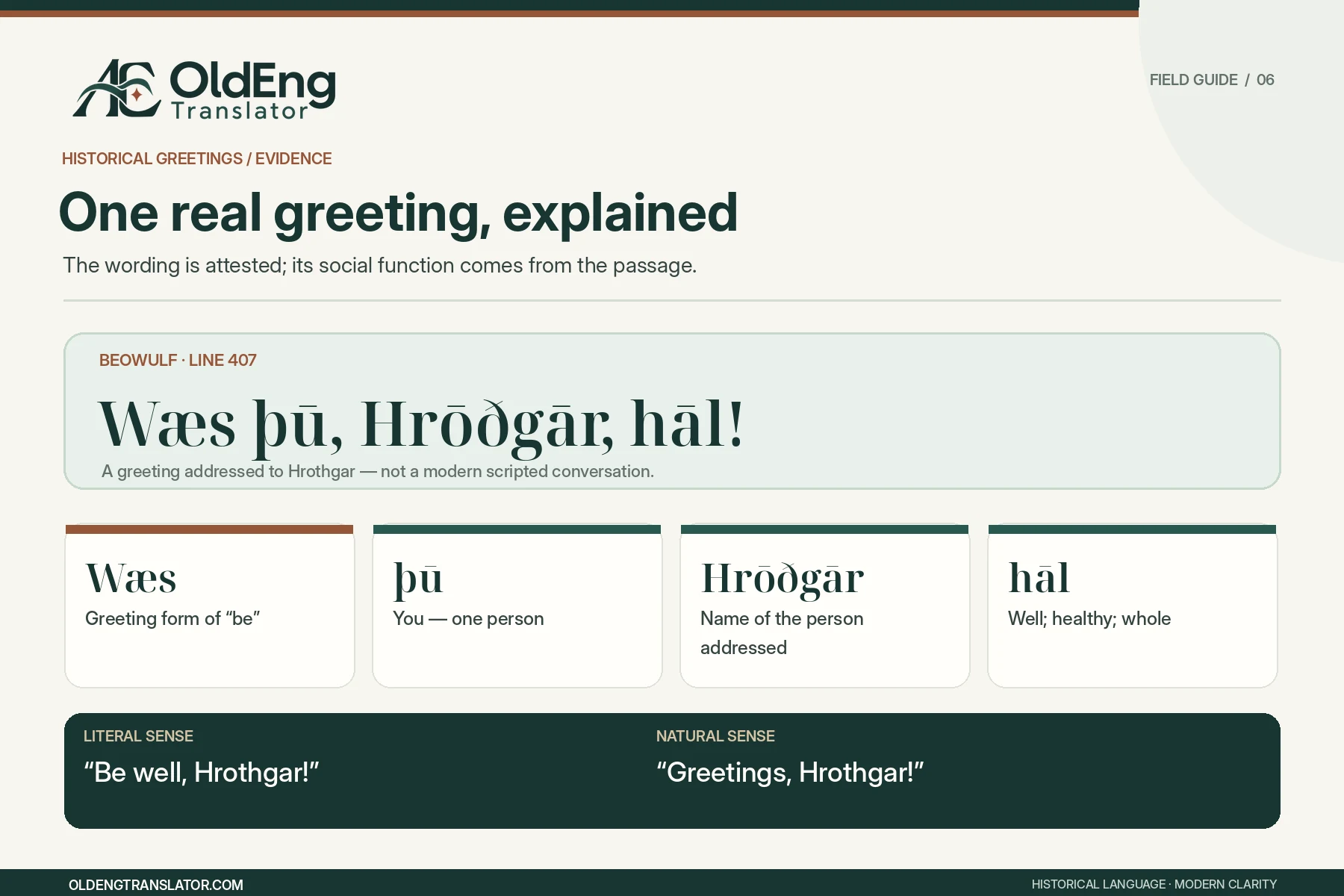
In the best-documented greetings, the speaker wishes the other person health or wholeness. HÄl meant sound, whole, or healthy; gesund likewise expressed health or safety. The wish could be phrased with an imperative of the verb “to be.â€
The famous encounter in Beowulf makes the function clear. When the hero is admitted to Hrothgar’s hall, he opens his speech with Wæs þū, HrÅðgÄr, hÄl! (line 407). In context this is a salutation addressed to a king, not the opening of a medical inquiry. Translating it as “Greetings, Hrothgar!†preserves its conversational purpose; translating it more literally as “Be well, Hrothgar!†preserves the wording of the good wish.
The cited edited line reads wæs, while the standalone greeting is often normalized as wes þū hÄl. The greeting is still understood as a wish, not as a statement that “you were healthy.†Manuscript forms, normalization, and editorial choices matter when comparing quotations.
One Person or Several?
Old English distinguished þū (one person) from gē (more than one). That distinction can affect the verb and adjective in a greeting.
- Wes þū hÄl addresses one person; þū makes the addressee explicit.
- Bēo þū gesund is another documented singular health-wish formula, with a different imperative verb form.
- HÄle wese gÄ“ addresses several people; the adjective and the verb phrase reflect the plural audience.
Forms with wes and forms with bēo are not necessarily interchangeable in every dialect or period. The surviving evidence suggests differences in regional and later West Saxon preferences. A learner can recognize both without insisting that one form was the only authentic greeting across the whole Old English period.
The letters also deserve care. Þū contains thorn, representing a th consonant, while the vowel in hÄl is conventionally marked long in modern editions. The Old English Pronunciation guide explains how those sounds are reconstructed; the purpose here is to establish what the phrase does in a historical encounter.
Welcome and Farewell Were Different Situations
A greeting on arrival, a welcome offered by a host, and a wish expressed when somebody leaves do related but different work. Old English evidence allows us to distinguish them.
Welcoming someone. The adjective wilcuma and related forms express that a person is welcome. In Beowulf, visitors are described as wilcuman to the Danish people. This is closer to “you are welcome here†than to a modern conversational response of “you’re welcome†after thanks. A statement such as GÄ“ sind wilcuman belongs to welcoming people, not automatically to accepting gratitude.
Wishing health on parting. An expression of well-being could serve at departure as well as arrival. Modern English uses different conventional words for hello and goodbye, but the historical evidence for Old English does not justify assuming that same division.
Wishing travelers safe arrival. In a surviving passage from Ælfric’s Life of Saint Maurus, the plural wish Farað nu gesunde and gesÇ£lige becumað tells people to go now safely and arrive happily. It is a useful example because it expresses departure and arrival, rather than simply attaching an English “goodbye†label to any phrase containing hÄl.
You may see far gesund recommended for one person. It is a grammatically intelligible singular construction meaning approximately “go safely.†The longer plural sentence is documented; the exact shortened singular formula should not be presented as a quotation from that passage without separate evidence. This is the difference between a form supported by historical grammar and a specific expression directly attested as written.
Why “Good Morning†and “Good Night†Need a Warning
Readers often search for an Old English equivalent of good morning, good afternoon, good evening, or good night. A literal translation can be assembled from historical words for good, morning, day, and night. That does not prove it was a customary Anglo-Saxon greeting.
Research into the history of English greetings places the familiar time-of-day salutation formulas in later stages of the language. Expressions routinely circulated online as gÅdne morgen or gÅdne dæg should not be labeled established Old English greetings without an identifiable contemporary example showing that use.
| Modern request | What the evidence supports | Responsible guidance |
|---|---|---|
| Hello | Health-wish greetings such as wes þū hÄl are documented. | Use a sourced health-wish formula when historical credibility matters. |
| Good morning / Good afternoon | The familiar fixed time-of-day greetings are not securely established as ordinary Old English formulas. | Do not mistake a literal modern reconstruction for an attested greeting. |
| Good evening / Good night | Words for evening and night existed, but that alone does not establish modern-style social formulas. | State the uncertainty rather than inventing a period quotation. |
| Goodbye | A health wish or a parting wish involving travel is historically supported. | Translate the social intention; do not assume the modern word had an identical Old English counterpart. |
The surviving record is heavily shaped by religious works, poetry, official documents, and what scribes chose to copy. Not attested means no supporting occurrence has been established in the evidence consulted; it is not proof that no person ever uttered anything similar. Still, the responsibility lies with anyone calling a phrase historically authentic to provide evidence for that claim.
The same caution applies to Ä“alÄ, an interjection sometimes given as “hello†in modern phrase lists. It can function as an exclamation or call for attention, but it should not be treated automatically as the everyday equivalent of modern hi.
Asking Names and Introducing Yourself
Not all useful Old English expressions are specialized greetings. Historical texts preserve questions, statements of identity, and descriptions of relationships. These offer a better basis for learning how a conversation can work than long invented scripts made to sound medieval.
An Old English version of “What is your name?†appears in the Gospel account at Luke 8:30:
Hwæt is þīn nama?
The wording is attested, but its occurrence in translated religious narrative does not establish that it was the standard polite opening of every social conversation. Here hwæt means “what,†þīn means “your†when addressing one person, and nama means “name.â€
The verb hÄtan provides another way to express being called by a name. The following short examples are constructed teaching sentences, not manuscript quotations:
| Constructed Old English | Modern English | Why the form works |
|---|---|---|
| Ic hÄtte Ælfred. | I am called Alfred. | HÄtte expresses “am calledâ€; Ælfred is an attested Old English personal name. |
| Ic eom Ælfred. | I am Alfred. | Uses the first-person pronoun and a form of “to be.†|
| Hū eart þū? | How are you? | A grammatical question, but not established here as a customary historical greeting. |
| Hwanon cymst þū? | Where do you come from? | Combines a question word with a second-person verb form. |
The constructed lines are useful for studying person and verb forms. They should not be introduced with “Anglo-Saxons always said…†merely because their individual words and constructions are familiar from Old English grammar.
The line following Beowulf’s greeting offers an especially revealing historical contrast: he identifies himself through his relationship to Hygelac and his social role. That introduction emphasizes kinship and allegiance, not simply a modern-style exchange of first names. It is a reminder that the function of an introduction may remain recognizable while its social conventions differ.
Thank You, Please, Sorry, and Other Useful Expressions
An English phrase list often assigns one Old English sentence to each modern social formula. That can be helpful for practice only if we distinguish a grammatical construction from evidence that it was used as a fixed politeness formula.
The following items are presented as vocabulary-supported or newly assembled examples; they are not all attested whole expressions.
| Modern intention | Old English wording | Evidence and usage note |
|---|---|---|
| I thank you (one person). | Ic þancie þē. | A grammatical construction using the attested verb þancian, “to thank.†Not proof of one universal fixed “thank you†formula. |
| I thank you (several people). | Ic þancie ēow. | Uses the plural form of “you†with the same verb. Constructed teaching form. |
| I ask you / I beg you. | Ic bidde þē. | A request formula; do not treat bidde as an independent, universal equivalent of “please.†|
| Forgive me. | Forgif mē. | An imperative request for forgiveness. It is not identical in range to every modern use of “sorry.†|
| I do not know. | Ic nÄt. | Uses a contracted negative form of the verb “to know.†|
| Yes / No | GÄ“a / Nese | Old English response words; choice and spelling can vary with context and source. |
| I love you (one person). | Ic lufie þē. | A grammatically constructed sentence, not evidence for a particular historical romantic formula. |
A phrase can be translated correctly at the level of grammar yet still miss an aspect of social meaning. In Modern English, “please†can accompany a request without the speaker explicitly saying “I ask you.†Old English had ways to make requests, but no single form should be imposed mechanically wherever English uses please.
Likewise, “you’re welcome†has at least two meanings in contemporary English: inviting or receiving someone, and replying to thanks. The historical wilcuma material supports the former; it is not evidence for the latter. A modern translator that fails to distinguish those meanings can produce a perfectly recognizable word in the wrong situation.
If an expression requires a particular noun ending, pronoun case, or verb form, those details matter as much as the dictionary meanings. Our Old English Grammar guide explains the relevant case and agreement system, while Old English Words and Meanings helps identify the historical vocabulary on which constructed examples depend.
How to Read and Reuse Old English Phrases Responsibly
Before copying a phrase into a learning exercise or a historical project, ask what sort of evidence is attached to it. A citation to a medieval work is different from a modern phrasebook example, and both are different from an isolated dictionary headword.
A reliable check has four parts:
- Find the complete expression. Does the cited source show the entire sentence, or merely the individual words used to construct it?
- Identify the context. Is this a greeting, a blessing, a command, a welcome to visitors, or a statement in a translated religious text?
- Check the grammatical audience. Does it address one person or several? Is the verb an imperative? Does the pronoun fit its role?
- Separate spelling from authenticity. A macron, thorn, or medieval-looking letter does not make a newly written sentence an historical quotation.
The last distinction is especially useful when comparing editions. One source may print wes, another wæs in the Beowulf greeting; another may replace þ with ð or modernize other letterforms. These differences need investigation, but they do not automatically mean the underlying expression has changed its social purpose. The Old English Alphabet guide explains such transcription and normalization issues in detail.
If your aim is to understand a surviving phrase, begin with the original source and its surroundings. If your aim is to compose a new phrase, first express the intended meaning clearly in Modern English, then check the vocabulary and grammatical forms, labeling the result as a modern composition where appropriate. The Old English Translator can help explore a proposed wording, but an automated result alone cannot certify its historical attestation.
Old English greetings offer a particularly clear lesson about historical translation: “be well†is more than a quaint replacement for “hello.†It is a documented expression of goodwill whose meaning, form, and social setting can be investigated. That is more useful than a long list of supposedly ancient expressions that the surviving evidence cannot verify.
Written by Arthur Westmer Editorial review: OldEngTranslator.com Editorial Team