Old English guide
How to Use an Old English Dictionary: Headwords, Word Forms, and Historical Meanings
Searching an Old English dictionary for bÄ“c can be surprisingly frustrating. You know the word may mean “books,†yet the entry you need is often headed bÅc , the singular form. Even after you find it, you have another decision to make: bÅc can refer to a book or, in some documentary settings, a charter. A successful lookup involves more than finding an English word beside an Old English spelling.
The essential skill is to move from the form written in a text to a possible dictionary headword, then use the entry’s grammar and examples to test the meaning. This guide shows that process with actual entries from the Bosworth–Toller Anglo-Saxon Dictionary. It also explains the abbreviations, variant spellings, and source references that make historical dictionaries unfamiliar to first-time users.
Which Old English Dictionary Should You Use?
Two major research resources serve somewhat different purposes.
Bosworth–Toller is a comprehensive historical dictionary compiled in an earlier period of scholarship. Its main volume appeared in 1898, with a supplement in 1921. The online edition hosted at Charles University makes entries searchable and provides access to scans of the printed dictionary. It is particularly useful for exploring a word’s forms, historical senses, and quotations from older editions of Old English texts.
The Dictionary of Old English (DOE), based at the University of Toronto, is a more recent, corpus-based scholarly project. Its entries are developed through systematic study of surviving texts, with detailed attention to senses and usage. It is being published in stages, so its coverage and access arrangements are not the same as those of a completed, freely browsable dictionary.
For most beginners, Bosworth–Toller is a practical first stop. For a difficult lexical question, a newer DOE entry, where available, may offer a more up-to-date analysis. These resources are not interchangeable with a Modern English-to-Old-English phrase generator: a historical dictionary documents words and evidence; it does not guarantee a ready-made translation of an unfamiliar modern idea.
Neither dictionary makes context unnecessary. A long entry may contain several senses that belonged to different texts, periods, or constructions. Your job is to identify which one the passage supports.
First, Turn the Word on the Page into a Headword
An Old English dictionary usually lists nouns under a citation form, commonly nominative singular, and verbs under an infinitive. The text you are reading may contain a plural, possessive, dative, past tense, or some other inflected form instead.
| Form you encounter | Useful headword to investigate | Why the spelling differs |
|---|---|---|
| bÄ“c | bÅc — book | Often nominative or accusative plural; other case analyses are also possible. |
| bÅcum | bÅc — book | Dative plural ending. |
| stÄnes | stÄn — stone | Genitive singular ending. |
| cÅm | cuman — come | Past singular of a strong verb. |
| sealde | sellan — give, hand over; sometimes sell | Past singular of a weak verb. |
| þone | The se/sēo/þæt demonstrative paradigm | Masculine singular accusative determiner, not a separate ordinary noun. |
These are candidate analyses, not a rule that each written form has only one interpretation. In particular, the historical entry for bÅc records bÄ“c in more than one case environment. You need the words around it to decide whether it refers to one book in an oblique case or several books.
The same caution applies to verbs. Sealde points toward sellan, but you still need the sentence to determine who performed the action and what was transferred. The Old English Grammar guide explains the inflectional patterns in detail; when using a dictionary, knowing how to recognize a possible pattern is often sufficient to find the right entry.
A Worked Lookup: From BÄ“c to BÅc
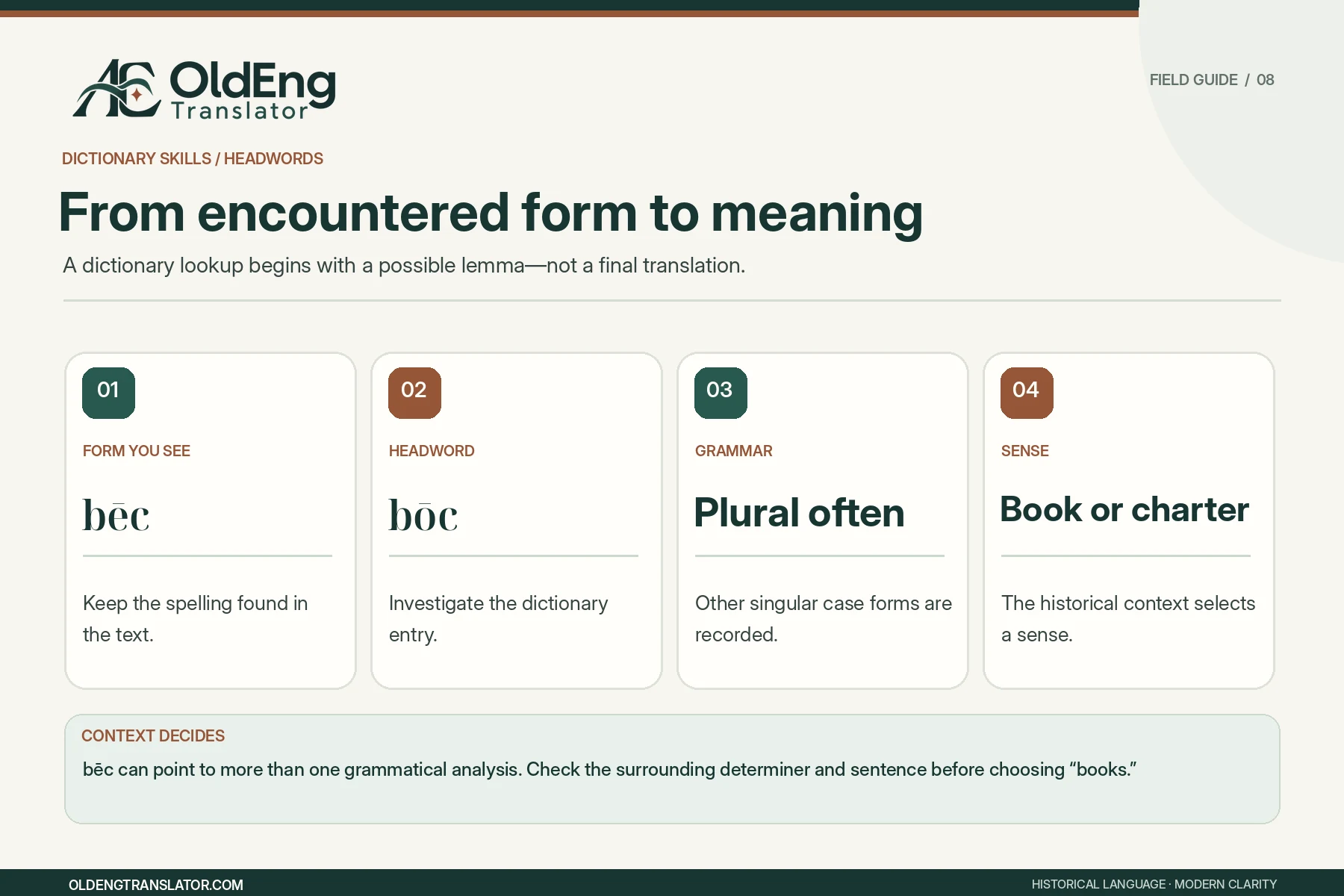
Take bēc as your unknown form. A modern English speaker might guess “books,†but a dependable dictionary lookup should establish both the word family and the grammatical possibilities.
Step 1: Keep the spelling you actually encountered. Note bēc in your working transcription. If a manuscript or edition prints bec without a macron, do not silently insert one into a quotation. Modern vowel-length marks are useful search aids, not automatically part of the original writing.
Step 2: Identify the possible base word. Old English has nouns whose plurals change their stem vowel. Try bÅc rather than assuming that a plural must end in -as. If the surrounding phrase includes Ã¾Ä bÄ“c, the plural analysis is strongly supported by the plural determiner.
Step 3: Read the grammar line, not just the definition. In Bosworth–Toller’s entry, bÅc is identified as a feminine noun. Its inflectional information includes bÄ“c as a nominative or accusative plural. It also records other case forms, including bÄ“c in singular environments. This is why a dictionary cannot assign a single grammatical label to the isolated spelling.
Step 4: Compare the senses. The familiar sense is “book,†but the dictionary also documents bÅc as a charter or written legal document. In a statement about a monastery’s books, the first sense may be appropriate; in a record concerning the transfer of land, the documentary sense deserves consideration.
Step 5: Check a cited occurrence. The entry quotes the Old English line:
Seó bóc is on Englisc awend
The sense is approximately “The book is translated into English.†Here seó bóc is singular, and the reference gives evidence for a particular usage rather than merely a dictionary editor’s unsupported guess.
You can examine the grammar, senses, examples, and source references together in the Bosworth–Toller entry for *bÅc*. The entry makes it possible to check the proposed interpretation against documented usage.
The result of the lookup is not “bÄ“c always means books.†It is: “This form belongs to bÅc; several grammatical readings exist; the context decides which one applies; and the noun itself has more than one historically documented sense.â€
Learn to Read the Information Around a Dictionary Entry
The headword is only the beginning. Traditional dictionaries compress much of their evidence into grammatical abbreviations, variant forms, historical quotations, and bibliographical references. Each part answers a different question.
| Entry notation | What it commonly tells you | How to use it |
|---|---|---|
| m., f., n. | Masculine, feminine, or neuter noun gender | Helps identify the agreement expected in a noun phrase. |
| g., d., acc. | Genitive, dative, accusative | Identifies recorded case forms or constructions. |
| sing., pl. | Singular and plural | Separates number from case. |
| p. / pret. | Past or preterite verb forms | Useful for recovering the infinitive from an encountered verb. |
| pp. | Past participle | Helps identify a form used in a larger verbal construction. |
| v., cf. | “See†and “compare†| Points to another entry, spelling, or related form. |
| Latin gloss | A Latin equivalent supplied in the dictionary or its evidence | Offers a historical clue, not always an exact Modern English definition. |
Abbreviation conventions differ between dictionaries and even between parts of a large older work. Always consult the resource’s own list of abbreviations when a label is ambiguous.
An older entry may also present an etymology, showing related words in other Germanic languages. That information can help explain a word’s history, but a cognate is not a translation. The fact that an Old English word resembles a Dutch or German form does not prove that both had the same meaning in the passage under examination.
The source references are especially valuable. A citation such as Homl. Th. ii. 358, 30 is a compact pointer to a passage in a published text edition. Its shortened title, volume, and location information allow the occurrence to be traced. It is not an extra definition, and it should not be copied into an article as though it were part of the Old English sentence.
Choose a Meaning from Usage, Not from Resemblance
A dictionary can correctly list several meanings without telling you which belongs in your sentence. Consider sellan. Its historical senses include giving, handing over, providing, and—in suitable contexts—selling for payment. The modern descendant sell makes the commercial meaning tempting, but Old English did not restrict the verb to that one sense.
The dictionary entry identifies past forms such as sealde and provides examples in contexts involving gifts, land grants, tribute, and other transfers. A passage mentioning a recipient and a gift may call for “gaveâ€; a context explicitly involving payment may support “sold.†Treating the first English word that comes to mind as decisive can add an exchange of money that the original does not establish.
The same principle applies to polysemy, the situation in which one word carries related but distinct meanings. BÅc can denote a written work or a charter; word can refer not only to an individual word but also, in appropriate contexts, to speech, a report, or a solemn statement. The dictionary collects evidence across these uses. Your text supplies the conditions for selecting among them.
A useful test is to write two possible glosses in the margin and ask what each predicts about the sentence. If one interpretation requires adding an unsupported person, object, or event, it is less persuasive. If the passage remains ambiguous, retain the uncertainty rather than creating a single confident translation.
For readers building their basic vocabulary, Old English Words and Meanings provides organized references. A dictionary lookup goes a step further: it tests a specific sense in a specific occurrence.
When Search Gives No Result, Check the Writing Before the Vocabulary
A failed search does not mean the word was absent from Old English. The obstacle may be the spelling, the editorial conventions of the edition, or the dictionary’s choice of headword.
Special characters. A source may use þ where another prints ð, or the historical ƿ where a modern edition prints w. Try a well-supported normalized spelling, but keep the original transcription available. Replacing these characters carelessly with visually similar Roman letters, such as p for wynn, may lead to a different word entirely.
Vowel length and variant spellings. Modern editions often mark long vowels with macrons, while manuscript spellings are less uniform. A search for bÅc and one for boc may behave differently depending on the dictionary’s search system. Do not assume every website automatically ignores diacritics or recognizes all spelling variants.
Strong verbs and altered stems. If an unfamiliar past form does not appear as a headword, consult a verb paradigm. CÅm belongs with cuman, just as sealde belongs with sellan, although the changes arise from different historical verb patterns.
Prefixes and compounds. An item beginning with ge-, be-, or another prefix may have an entry of its own. Search both the full form and plausible related headwords, but do not strip the prefix mechanically: it can change the lexical meaning. Compounds may be indexed under the whole word or related component entries.
Scribal abbreviations and word division. A manuscript transcription can preserve a sign that a reading edition expands. Check whether you are searching for an abbreviation, a normalized word, or a sequence whose spacing has been interpreted by an editor. The Old English Alphabet reference explains common manuscript signs and modern substitutions without turning them into separate vocabulary items.
If none of these checks works, record the exact spelling and where it appears. A rare word, damaged reading, or unrecognized manuscript form may require a scholarly edition rather than another speculative search term.
How Much Can You Trust a Historical Dictionary?
A historical dictionary is an organized account of evidence, not a guarantee that every interpretation is final. Bosworth–Toller remains valuable because it covers a vast body of vocabulary and preserves textual examples. Yet its principal volumes were compiled under the scholarly conventions of the nineteenth and early twentieth centuries. Some entries may reflect older readings, incomplete evidence, or analyses later revised by specialists.
The Dictionary of Old English was designed to investigate lexical evidence more systematically through a corpus of surviving Old English texts. The University of Glasgow’s Thesaurus of Old English offers another way to explore relationships among meanings. A thesaurus is especially useful when investigating a concept, but its categories should not be mistaken for proof that any chosen word fits a sentence.
For a consequential or disputed translation, look for agreement among the entry, the cited original passage, and more recent scholarship where available. If an old dictionary gives an uncertain gloss with a question mark, do not remove the uncertainty when presenting the definition. If a citation points to a manuscript or edition you cannot inspect, describe the evidence honestly rather than implying you checked it directly.
Dictionary coverage and historical attestation are also different claims. A word can be well documented without every conceivable sentence containing it being attested. Conversely, a search that yields no entry may reflect the resource’s coverage or indexing decisions, not proof that a speaker never used the form.
A Short Lookup Record That Prevents Common Mistakes
When you meet an unfamiliar word in a passage, a compact record is usually more useful than copying an entire long dictionary entry.
| Record | Example for bēc | Why it matters |
|---|---|---|
| Written form | bēc | Preserves what you are actually trying to explain. |
| Candidate headword | bÅc | Gives the dictionary entry to consult. |
| Possible grammar | Often nominative/accusative plural; other cases possible | Prevents a form being assigned a role without context. |
| Relevant senses | Books; perhaps documentary sense in a suitable context | Keeps meaning tied to subject matter. |
| Context check | Look at determiner, verb, and surrounding text | Tests both grammar and meaning. |
| Evidence | Entry, cited passage, and edition if consulted | Makes your decision reviewable. |
This record works for a simple lookup or a difficult disputed one. It keeps separate what you saw in the text, what you inferred from the form, and what the historical evidence actually supports.
The wider process of turning a passage into Modern English, including sentence structure and final phrasing, belongs to How to Read and Translate Old English. Dictionary work occupies one crucial part of that process: connecting an encountered form to a defensible meaning. For an exploratory first reading, you can also try the Old English Translator, then test any uncertain words against their headwords and historical usage.
A good lookup ends not with “I found a translation,†but with a stronger, answerable claim: this form belongs to this word; these grammatical readings are possible; and this sense best fits the source.
Written by Arthur Westmer Editorial review: OldEngTranslator.com Editorial Team