Old English guide
Beowulf Opening Lines Explained: Translation, Meaning, and Scyld Scefing
The first word of Beowulf is Hwæt . Before the poem introduces Grendel, the hero's arrival, or the battles for which it is famous, it asks its audience to remember the great deeds of Danish kings. Within eleven lines it tells the story of Scyld Scefing: a ruler who rose from a vulnerable beginning to command neighbouring peoples and receive their tribute.
Those lines are compact enough to read closely, but a literal word-for-word translation can obscure their meaning. The word Hwæt is disputed; GÄr-Dena names a people rather than a weapon; meodosetla refers to the hall-seats Scyld took from enemies; and the closing praise of a “good king†carries a political meaning within the poem. Here is a source-checked reading of the opening, with the Old English words, grammatical relationships, and poetic effects kept distinct.
The Opening of Beowulf in Old English and Modern English
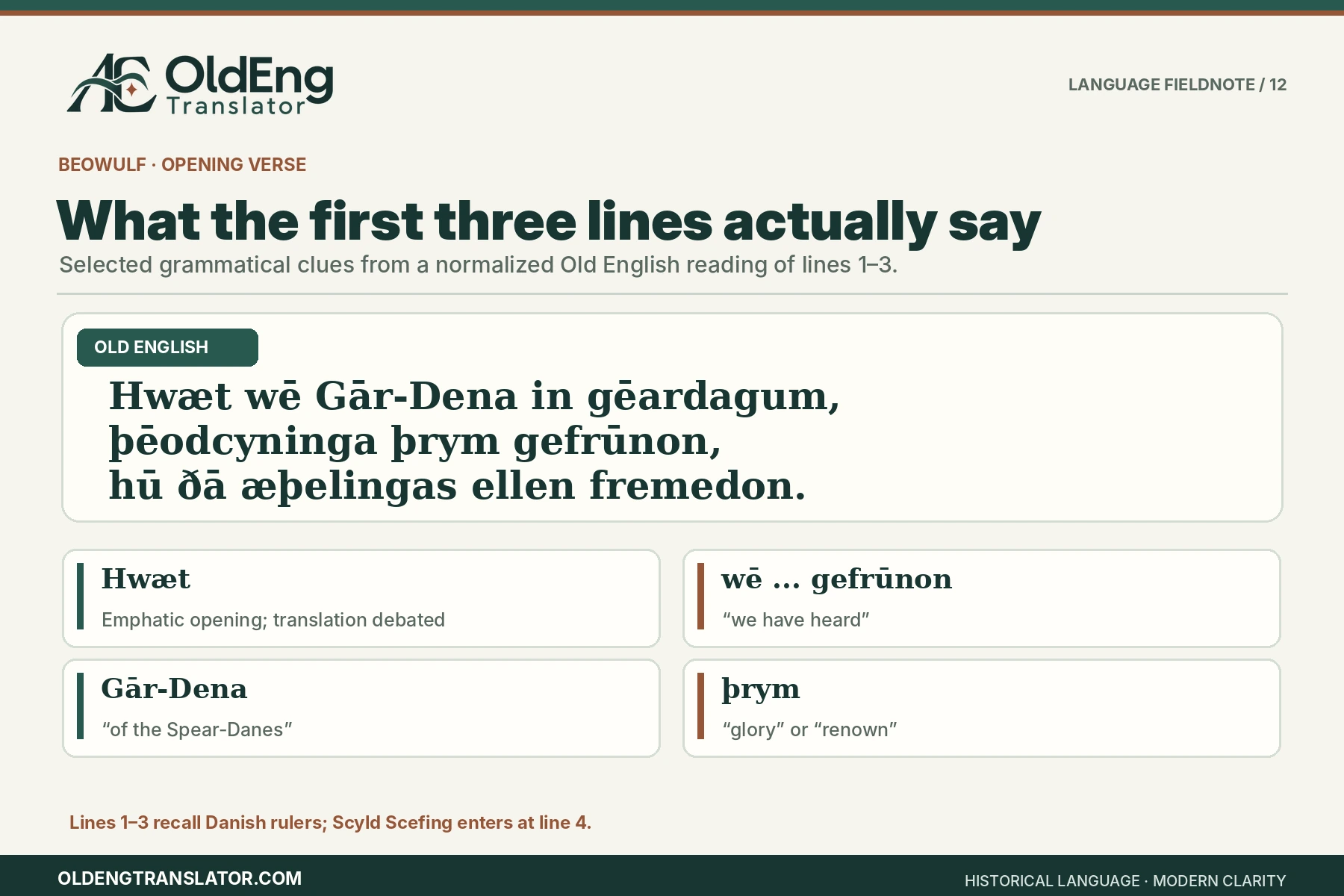
The first three lines, in a common normalized editorial spelling, read:
Hwæt wÄ“ GÄr-Dena in gÄ“ardagum, þēodcyninga þrym gefrÅ«non, hÅ« Ã°Ä Ã¦Ã¾elingas ellen fremedon.
Close translation of lines 1–3: “We have heard of the glory of the Spear-Danes’ kings in days long past, and how those noble rulers performed deeds of courage.†The opening Hwæt lends the statement an emphatic or exclamatory force, but whether it should become a separate “Listen!†in Modern English is debated.
A continuous reading of lines 1–11: “We have heard of the renown of the Spear-Danes’ kings long ago, and how those princes showed their courage. Scyld Scefing repeatedly deprived bands of enemies and many peoples of their mead-hall seats, and struck fear into warriors. Although he had first been found destitute, he lived to find relief from that condition. He grew in stature beneath the sky and gained honour, until the surrounding peoples, even across the sea, had to obey him and pay tribute. That was a worthy king.â€
This is a new explanatory prose translation, not a quotation from a published Modern English translator. The paraphrased later lines are meant to be read alongside the original, not substituted for it in textual scholarship. For a full Old English text of the first twenty-five lines, grammatical analyses, and a separately authored translation, consult the University of Texas at Austin’s *Beowulf: Prologue* lesson. This is the sole external reference linked in this article.
Editors differ in punctuation, macrons, word division, and sometimes their treatment of difficult readings. The line numbering used below is the conventional numbering of the Old English poem. The first three lines above show a teaching normalization, rather than a diplomatic transcription of the manuscript page.
What Does Hwæt Mean at the Beginning of Beowulf?
Hwæt is related to Modern English what, but translating the beginning as the literal question “What?†would miss its role in this passage. The poet is announcing received knowledge of past royal achievements. Traditional translations open with “Lo!†or “Listen!â€; some modern versions use “So,†“Well,†or no independent exclamation at all.
The disagreement is linguistic, not merely a contest over which modern expression sounds dramatic. In a 2013 study, linguist George Walkden argued that hwæt functions within an exclamatory clause rather than as a freestanding interjection. Other scholars retain a traditional attention-getting interpretation. The medieval manuscript does not contain the modern exclamation point that readers encounter in many printed editions, and editorial punctuation should not be mistaken for evidence of exactly how a performer delivered the first word.
The safest explanation is that the whole opening has an emphatic, audience-facing character. “We have heard†(wÄ“ … gefrÅ«non) introduces a story already worth knowing. A translator might preserve that effect with an introductory “Listen,†but should not claim that Hwæt! has one universally agreed English equivalent.
Lines 1–3: The Spear-Danes, Their Kings, and Their Deeds
The first sentence is built around wÄ“ … gefrÅ«non: “we have heard†or “we learned of.†Several words intervene before the verb. That arrangement is natural in Old English verse but becomes easier to follow when the grammatical pieces are separated.
| Old English expression | Function in the sentence | Meaning in context |
|---|---|---|
| wÄ“ … gefrÅ«non | First-person plural subject and past verb | We have heard or learned of |
| GÄr-Dena | Genitive plural referring to a people | Of the Spear-Danes |
| in gēardagum | Prepositional phrase, with dative plural | In former days, long ago |
| þēodcyninga | Genitive plural compound | Of the people’s kings, or rulers of nations |
| þrym | Noun; central object of what has been heard | Glory, power, renown |
| hÅ« … fremedon | Clause explaining the remembered achievements | How they performed |
| Ã°Ä Ã¦Ã¾elingas … ellen | Noble figures and the courage attributed to them | Those princes performed deeds of valour |
The Spear-Danes are not the later hero’s Geatish people. GÄr means spear, and Dene means Danes. The compound invokes a named Danish group in the poem’s legendary past; it is not an instruction to imagine that every Dane literally carried a spear at every moment.
Similarly, þēodcyninga is a compound built from terms for a people and a king, while þrym is the glory or power that has been remembered. The sentence is about the reputation of rulers, not about the appearance of their crowns or the exact borders of their territory.
The paired words æþelingas (nobles, princes) and ellen (courage, valour) complete the thought. Old English fremedon is a past plural form of “perform†or “do.†The poet announces the kind of deeds the story will celebrate before identifying a particular king. If you want to trace one of these inflected forms back to its dictionary entry, the method in How to Use an Old English Dictionary applies; the distinctive task here is seeing how those forms create the opening declaration.
Lines 4–6: Why Scyld Scefing Takes Centre Stage
The first person named is Scyld Scefing, not the Geatish warrior Beowulf. Scyld is an ancestral Danish ruler associated with the royal line later called the Scyldings. The poem begins by establishing the standing of the Danish kingdom before the narrative reaches Hrothgar’s hall and the hero who will eventually visit it.
Scyld’s career is described through strikingly compressed language. The opening of line 4 names him and then evokes bands of enemies; the following line adds many tribes or peoples. The verb oftÄ“ah, from a verb meaning to deprive or take away, governs the idea of taking meodosetla—mead-seats or mead-benches—from them. Then egsode tells us that he terrified their warriors or nobles.
A mead-hall seat is more than a piece of furniture in this context. Feasting and the lord’s hall belong to the social and political world of the poem. Taking a rival people’s mead-seats evokes the displacement of an enemy’s authority, although the lines do not provide a detailed account of a specific assault on a particular building. Rendering the action simply as “stole chairs†would miss its scale; inventing a fully described siege would go beyond the text.
Scyld Scefing is also a name requiring restraint. Scyld resembles the word for “shield,†and Scefing suggests a relationship with Scef or Sceaf, a name associated with later traditions. The form can be explained as “Scyld, associated with Scef/Sceaf,†often understood as “son or descendant of Scef.†The opening lines alone do not supply a complete family biography, and the legendary traditions surrounding those names should not be inserted into the translation as though they were present in lines 4–6.
Lines 6–8: From Being Found Destitute to Gaining Honour
The poem then turns unexpectedly from Scyld’s victories to a vulnerable beginning. It describes him as fÄ“asceaft funden—roughly, “found destitute†or “found helpless.†The following statement says he experienced relief or consolation for that earlier condition. He went on to grow and flourish in reputation.
The contrast matters more than a single dramatic English adjective. His authority is portrayed as a reversal of fortune: someone once without secure resources became a ruler whom others feared and honoured. The surrounding passage does not specify every detail of the moment when he was found. Retellings sometimes supply an elaborate infant-arrival scene, but the first eleven lines themselves do not narrate the circumstances of his discovery. Readers should separate what the wording says from the wider legend or a modern adaptation.
Two short verbal forms carry the rise. WÄ“ox means “grew,†from the verb related to Modern English wax in the older sense of increasing. ÞÄh means “prospered†or “flourished,†here in honour or esteem. The skyward expression in between gives the change a broad poetic setting: Scyld’s growth takes place under the heavens, while his stature increases among human communities.
This is not a dated royal chronicle. There are no reign years, campaign locations, or reliable biographical documents in these opening lines. Their work is narrative: to establish the remarkable transition from precarity to power.
Lines 8–11: The Whale-Road, Tribute, and a “Good Kingâ€
Scyld’s growing power reaches beyond his immediate followers. The poem says that surrounding peoples were obliged to obey him and pay tribute. The paired verbs matter: hȳran can mean hear or obey, while gyldan here conveys paying or rendering what is owed. The noun gomban means tribute, not an ordinary gift freely offered between friends.
The geographical expression hronrÄde is traditionally translated “whale-road.†It is a poetic compound denoting the sea. It should not be read as a mapped road used by whales or as evidence for a specific maritime journey. The image makes the waters part of the extent of Scyld’s influence. In context, people beyond the sea, as well as neighbouring peoples, come within the reach of his reputation and demands.
The account closes with the compact judgement “That was a good king.†Modern editions often supply a macron in gÅd to mark the adjective “goodâ€; manuscripts do not consistently show such modern length marks. The line does not say that Scyld was gentle in all circumstances. The actions just described include intimidation, military dominance, and compelled tribute.
That tension is central to the meaning. Good kingship in the poem’s opening is associated with an effective ruler’s ability to establish security, status, and political power. The praise belongs to the poem’s heroic world and should not be flattened into a modern moral assessment that ignores how Scyld attained his position. Nor does it prove that the narrator approves of every possible act of conquest. It establishes a standard of admired rulership against which later Danish kings can be understood.
How the Opening Sounds: Alliteration Instead of End Rhyme
Beowulf is written in Old English alliterative verse, not in rhyming couplets. A typical line has two half-lines separated by a pause, with stressed syllables connected by shared initial sounds. The arrangement is designed around patterns of stress and alliteration, though its detailed metrical analysis involves more than simply counting repeated letters.
The opening offers several examples:
- GÄr-Dena / gÄ“ardagum: initial g links the Spear-Danes with the distant past.
- þēodcyninga / þrym: the repeated þ emphasizes the kings and their renown.
- æþelingas / ellen: the stressed opening vowels alliterate, as vowels can do in Old English verse.
- Scyld / Scefing / sceaþena: the repeated opening sc sound binds Scyld’s name to the enemies he confronts.
Those connections operate across the verse’s stresses, not as pairs of words chosen merely because their spellings look alike. A modern English translation can preserve the meaning without recreating every sound pattern; a poetic translation may instead choose new alliteration to convey something of the original’s effect.
There is also an important difference between the poem’s line breaks and its sentences. The first three verse lines form a single sustained thought; the description of Scyld runs across multiple later lines. Translating every half-line as an independent English sentence risks breaking the relationships that the original grammar holds together.
For help sounding out the Old English rather than guessing from modern spelling, see Old English Pronunciation. The poem’s metre is distinctive, but its words still belong to a historical language with reconstructed vowel and consonant values.
Which Beowulf Is Being Discussed—and When Was the Poem Written?
The title creates an easy trap: the opening eleven lines are about Scyld Scefing. The Geatish hero Beowulf, who will fight Grendel, does not appear in this passage. Shortly afterward, the poem names an heir of Scyld who is sometimes identified in textual and genealogical discussions as Beow or Beowulf. That Danish figure should not be casually equated with the later Geatish protagonist merely because of a similar or identical written name.
The surviving medieval copy of Beowulf belongs to the manuscript now catalogued as British Library Cotton MS Vitellius A XV, within the Nowell Codex. The British Library dates that codex to the very end of the tenth century or the first decades of the eleventh. The poem’s original date of composition is debated and cannot be derived simply from the age of the surviving book.
The manuscript also has its own history. More than one scribe worked on the codex, and the collection was damaged in the Cotton library fire of 1731. The opening has survived, but the modern readable page—complete with punctuation, separated verse lines, and optional macrons—is an edited presentation of manuscript evidence, not a photograph-like reproduction of exactly what the medieval scribe wrote.
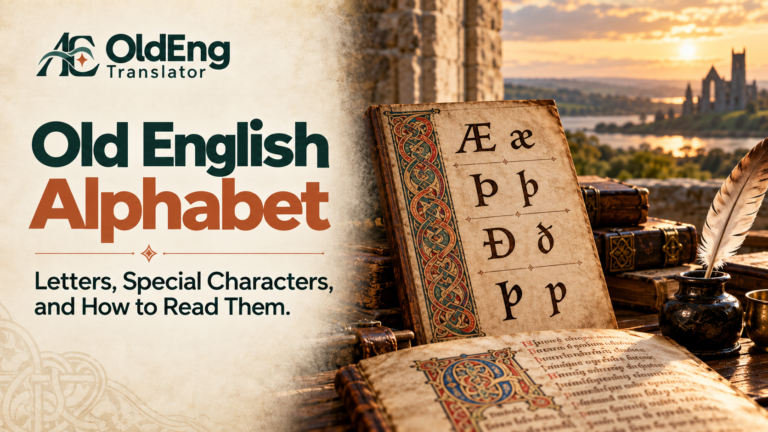
That distinction matters when readers compare versions. An edition may begin Hwæt! while another prints Hwæt, or leaves the word connected more closely to the following clause. Some modernizations use þ where another text uses ð, or make editorial decisions about compounds and vowel length. These differences should be checked against the edition before anyone claims that a word has been misquoted. The Old English Alphabet guide covers the manuscript-versus-edition distinction, while Old English Dialects explains why a normalized written form should not be mistaken for one universally spoken Old English variety.
What the Opening Establishes Before Grendel Appears
The first eleven lines do not yet tell the audience about Grendel’s attack, Hrothgar’s distress, or the Geatish hero’s answer. Instead, they give the Danish royal world a history and a measure of greatness. The poet begins with reported ancestral fame, narrows the focus to Scyld’s conquest and ascent, then concludes with a verdict on kingship.
That sequence does three pieces of literary work. It makes the Danes more than anonymous people waiting to be rescued. It introduces honour, inherited authority, and the bonds of obedience as central concerns. And it asks readers to remember that a kingdom which appears powerful in one generation can become vulnerable in another—an idea that will gain force once the narrative reaches Hrothgar’s hall.
A reader checking an unfamiliar word should keep the entire sequence in view. Þrym is the reputation of rulers; the mead-seats evoke control of communal and royal space; the tribute shows power over others; and the final judgement tells us how the narrator frames that power. None is adequately explained by a solitary dictionary gloss.
If you are working from the Old English text, the steps in How to Read and Translate Old English help separate the source’s grammar from a fluent Modern English rendering. For an exploratory interpretation of an individual word or phrase, the Old English Translator can provide a starting point, but the wording of Beowulf should ultimately be checked against a reliable edition and its context.
The opening is memorable because it manages so much in so little space. It begins in shared memory, makes kingship visible through action, and turns one man’s change of fortune into the measure of a dynasty. Understanding those moves is more revealing than memorizing Hwæt as a single English exclamation.
Written by Arthur Westmer Editorial review: OldEngTranslator.com Editorial Team